

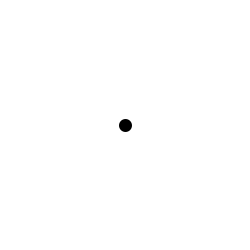
Point
Symbolic Profile
Primary Name: Point (Bindu / Monad's Center)
Common Aliases: Bindu, The Center, The Unmoved Mover, The Non-Dimensional Source, Primordial Seed, Circumpunct, Microcosmic Kether, The First Cause, The Singularity, The Unmanifest Apex
Visual Core (the baseline shape): A single non-dimensional location in space without length, breadth, or depth; the zero-dimensional locus or dot
Exoteric Keywords (surface meaning): Origin, focus, location, position, center, beginning, sharpness, destination, mark, punctuation
Esoteric Keywords (occult meaning): Bindu (Primal Energy Seed), Kether (The Crown), Ain (Nothingness / Unmanifest Potential), Unmoved Mover, The Circumpunct (Point within the Circle), Radiating Source, Monad's Essence, Spatial Singularity, Axis Mundi Pivot
Astrological or Planetary links: The Sun (☉, As the central point within the circumpunct / Sol), The Pole Star (Polaris / Fixed Axis), Kether on the Qabalistic Tree of Life, The Central Fire of the Cosmos
Alchemical Associations: The Circumpunct (Point within the Circle), The Lapis / Seed of Gold, The Spark of Life (Scintilla), Prima Materia in its unextended state, Central Heart of Mercury
Associated Metals: Gold (Solar Center), Quicksilver / Mercury (Fluid Singularity), Electrum
Traditional Colours: Pure White (Unmodified Spirit / Kether), Golden Ray, Radiant Gold, Intense Indigo/Black (The Void / Bindu of Transcendent Night)
Form and Origin
Natural or Material Inspiration
The symbol of the point is inspired by the most fundamental natural and astronomical phenomena observable in the universe. In the night sky, the point is embodied by the immobile Pole Star (Polaris) around which the entire celestial vault appears to rotate, as well as distant stars appearing as infinitely small pinpricks of light. On Earth, it reflects the physical center of gravity in a body, the central seed or nucleus within a plant cell or fruit, the tiny point of impact made by a falling water droplet before ripples expand outward, and the central pupil of the eye through which consciousness perceives the world.
Geometric Philosophy
Geometrically, the point represents the ultimate zero-dimensional primitive—an entity having position but no length, width, or depth. Because it lacks physical extension, a true mathematical point is unmanifest and invisible to mortal sight, serving as the necessary precursor to all geometry. When a point moves, it generates a one-dimensional line; when a line moves, it generates a two-dimensional surface; and when a surface moves, it generates three-dimensional volume. In sacred geometry, the point symbolizes pure, unextended Spirit (Unmoved Mover), the indivisible Monad that contains all possibilities of form, space, and time enfolded within its zero-dimensional self.
Historical Evolution of the Form
The iconography of the point evolved from Paleolithic cup marks and dot-pattern petroglyphs into the sacred foundational symbol of ancient Mediterranean and Asian cosmologies. In ancient Egypt, the point within a circle (circumpunct) signified Ra, the solar light and supreme spiritual principle. In Pythagorean mathematics, the point was defined as "unity having position," acting as the parent of all numbers. In Tantric and Vedic traditions of India, the dot became the Bindu—the metaphysical drop of creative power marked on the forehead (third eye). In medieval alchemy and Rosicrucianism, the point represented the Scintilla or divine spark hidden within matter, while early modern mathematics formalized it through Cartesian coordinate systems as the origin (0,0).
Mythological and Cultural Context
The Origin Point
The point's earliest cultural appearances occur in Paleolithic cave art, cup-and-ring carvings, and Neolithic fertility artifacts where small drilled dots represented seeds, stars, or eyes of the Earth Mother. In ancient Near Eastern and Mesopotamian creation myths, manifestation begins when an unmanifest divine singularity emits a primary sound or light ray from a central "navel" (omphalos). In Hermetic and Gnostic texts, the universe is described as emanating from an unapproachable, occult point of pure Being (Ain Soph) into the void.
Cultural Migration
As sacred geometry developed globally, the point retained its status as the universal symbol for the Divine Source and cosmic center. In Hindu and Buddhist traditions, the point (Bindu) was placed at the heart of mandalas, yantras (such as the Sri Yantra), and the Aum glyph, representing the locus where the unmanifest (Nirguna Brahma) transforms into manifest reality (Saguna Brahma). In Qabalah, the point represents the initial emanation of Kether out of Ain Soph. In Chinese Daoism, it is the Tai Chi ridgepole, the still center between Yin and Yang. In Western ceremonial magic and Freemasonry, the point within the circle (circumpunct) represents the individual practitioner standing at the center of consecrated space bounded by divine law.
Folklore and Ritual Use
In folk customs and spiritual practice, the point is deployed as a focusing tool and a talisman of spiritual orientation. In Indian culture, the tilak or bindi dot applied to the forehead between the eyebrows marks the Ajna chakra, directing attention inward to the seat of soul awareness. In ritual magic, marking a central point on the ground with a dagger or chalk is the indispensable first step before inscribing protective circles or laying temple foundations. In Masonic tradition, the dot was used by medieval stone guild masters as a secret mark of authorship and a symbol of master craftsmanship.
Esoteric and Psychological Depths
Jungian Archetypes
In analytical psychology, Carl Jung recognized the central point within a mandala or dream as the ultimate symbol of the Self—the core organizing center of the total psyche. While the ego operates on the periphery of conscious awareness, the central point represents the transcendent center where conscious and unconscious forces are reconciled. Locating or drawing the central point in therapy signifies "centroversion": the psyche's instinctual drive to find its true center of gravity, achieve self-regulation, and overcome ego-fragmentation.
Occult and Mystical Usage
In Hermeticism and Qabalistic magic, the point is the operational pivot of all ritual. As the Qabalistic Sefer Yetzirah and Zohar explain, the primordial point (Punto) is the first concealed degree emanating from the pure ether of Ain Soph, containing all future worlds enfolded within it. In Tantric yoga, meditation upon the Bindu at the Ajna chakra or within the Sri Yantra allows the practitioner to collapse mental fluctuations (vrittis) back into the quiet void of pure consciousness. In alchemy, finding the "point of peace" at the center of the cross or circle represents isolating the Quintessence (Lapis Philosophorum).
Dream Symbology
Dreaming of a brilliant dot, a single shining star, a central eye, or a point of intense light in dark space signifies an impending spiritual awakening, the discovery of one's life purpose, or a sudden intuitive epiphany. It indicates that the subconscious mind is condensing scattered emotional energies into a unified focus. Dreaming of losing one's center or being unable to find the central point indicates feelings of disorientation, boundary dissolution, and the need to ground oneself in core values.
Themes and Pairings
Core Thematic Associations
The primary themes associated with the point are the Unmoved Mover, primordial origin, spatial singularity, non-dimensional unity, the divine spark (Scintilla), absolute focus, the seed of creation, and the central pivot around which all cycles revolve. It represents the unmanifest Cause prior to time and space, holding infinite energy and intelligence in a state of absolute equilibrium.
Traditional Pairings
The point is traditionally paired with the Circle (The Point within the Circle / Circumpunct / ☉), the Line (The extension of the Point into motion), the Cross (The intersection establishing the central point), the Compass (The fixed leg resting on the point while the moving leg scribes the perimeter), the Vesica Piscis (Two points establishing the line of tension), and the Bindu within the Yantra.
Contrasting Symbols
The direct polar opposites of the point are the Bounded Square / Cube (Representing materialization, solid volume, and spatial extension vs. non-dimensional spirit), the Circumference / Perimeter (Representing outer cyclic motion and surface change vs. inner stillness), and Chaos / Infinite Fragmentation (Representing dispersed, uncentered entropy).
Quotations
"The point is the source of our whole of wholes. It is beyond understanding, unknowable, silently self-enfolded. But like a seed, a point will expand to fulfill itself as a circle."
Michael S. Schneider, A Beginner's Guide to Constructing the Universe, 1994
"The Centre is, above all, the origin, the point of departure of all things; it is the principial point, without form and without dimensions, therefore indivisible, and thus the only image that can be given to the primordial Unity."
René Guénon, Fundamental Symbols: The Universal Language of Sacred Science, 1962
"This degree is the sum total of all subsequent mirrors... They proceed therefrom because of the mystery of the point, which is in itself an occult degree emanating from the mystery of the pure and awe-inspiring ether."
Moses de León, The Zohar / Sefer Ha-Zohar, c. 1280
Reference Library
Notable Masterworks
- Monas Hieroglyphica (The Hieroglyphic Monad Diagram) — Dr. John Dee (1564, Antwerp)
- The Sri Yantra Diagram (Mother of All Yantras) — Ancient Indian Tantric Art / Copper Plate Engravings (c. 1st Millennium BCE / Medieval Manuscripts)
- Dante and Beatrice Gaze into the Point of Light (Paradiso Canto XXVIII Illustration) — Gustave Doré (1868)
- The Punto / Monad in Utriusque Cosmi Historia — Robert Fludd (1617)
Primary Texts
- The Zohar (Sefer Ha-Zohar, Treatise on the Primordial Point and Light of Kether)
- Shiva Sutra Vimarshini (Tantric text on Bindu, Nada, and the vibration of the divine point)
- René Guénon: Fundamental Symbols: The Universal Language of Sacred Science (Chapter 8: "The Idea of the Centre in the Traditions of Antiquity")