

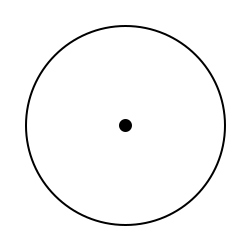
Point within a Circle
Symbolic Profile
Primary Name: Point within a Circle
Common Aliases: Circumpunct, Solar Glyph, Glyph of Ra, Monad in Manifestation, Punto-Circulus, The Eye of Light, The Seed in the Womb, The Central Sun, Circulus Simplex with Center
Visual Core (the baseline shape): A single zero-dimensional central dot or point placed at the precise center of an enclosing 360-degree circle
Exoteric Keywords (surface meaning): Sun, focus, target, center, solar system, completion, boundary, gold, origin, enclosure
Esoteric Keywords (occult meaning): Circumpunct, Ra/Sol, Monad in Manifestation, Unmoved Mover, Kether in Malkuth, Divine Spark in Matter, Phallus in Yoni, Axis Mundi, Singularity of Creation
Astrological or Planetary links: The Sun (☉, Universal astrological and astronomical glyph for Sol), Pole Star / Polaris at the cosmic pivot, Path of Tiphareth and Kether on the Tree of Life
Alchemical Associations: Gold (Aurum), The Seed of Gold (Scintilla), Fixed Sol, Fertilized Prima Materia, Heart of Mercury at the Pole, Solve et Coagula Equilibrium
Associated Metals: Gold (Sun/Sol), Electrum, Quicksilver (Mercury)
Traditional Colours: Gold, Solar Yellow, Pure White (Kether / Unmodified Light), Black Dot on White Field (The Seed in the Void)
Form and Origin
Natural or Material Inspiration
The point within a circle is inspired by the physical observation of the solar disk with its radiant core, the human eye with its dark pupil centered within the circular iris, and the Pole Star (Polaris) standing immobile at the center of the revolving night sky. It also mirrors the structure of a biological cell or fertilized ovum containing its central nucleus, as well as the initial circular ripple expanding outward from the single point where a stone strikes a quiet body of water.
Geometric Philosophy
Geometrically, the circumpunct represents the dynamic relationship between the unmanifest zero-dimensional origin (the point) and its complete radial expansion into manifest space (the circle). The central point is the indivisible, motionless source—the Unmoved Mover—while the perimeter represents the 360-degree limit of its influence. The symbol demonstrates how unity (Monad) projects its inherent potential outward in all directions equally, establishing both the boundary (ring-pass-not) and the stabilizing center without which the circumference would collapse.
Historical Evolution of the Form
Dating back to prehistoric petroglyphs and Egyptian hieroglyphs, the circumpunct was recorded as the emblem for light, day, and the solar deity Ra. In classical antiquity, Pythagoras and his disciples adopted it to symbolize the Monad, the divine source of all numbers. During the Renaissance, alchemists adopted the symbol as the universal glyph for Gold (Aurum), while astronomers established it as the standard character for the Sun. In Rosicrucian and Freemasonic traditions, the glyph evolved into a central symbol of moral order and divine providence, bounded by the two parallel lines of the Saints John.
Mythological and Cultural Context
The Origin Point
The earliest documented appearances of the point within a circle occur in Paleolithic and Neolithic rock art, as well as Old Kingdom Egyptian inscriptions where it served as the hieroglyph for Ra, the Sun, and the concept of time (day). In ancient Egyptian theology, each of the 28 divisions of the Royal Cubit was consecrated to a divinity, with the very first division—representing the number one and primary divine unity—bearing the circumpunct glyph of Ra.
Cultural Migration
The symbol migrated from ancient Egyptian solar theology into Greek Pythagorean geometry, where it represented the Monad radiating space and number into being. In Asian traditions, it found expression as the Chinese jade disk Pi with its central aperture, and as the Bindu placed within the central circle of Indian mandalas and yantras. In the Near East and Islamic tradition, the symbol informed the architectural design of sacred precincts and cities, while Western Hermeticism, Alchemy, and Freemasonry preserved the glyph as the emblem of the Supreme Architect and the individual soul centered within cosmic law.
Folklore and Ritual Use
In folk magic and ceremonial practices, the point within a circle serves as a protective talisman and a method for establishing sacred space. Ancient surveyors and geomancers placed a central gnomon (stick or pillar) into the earth to mark the central point, drawing a circle around it to track solar shadows and establish the cardinal axes of temples and settlements. In Masonic lodge ritual, the candidate is instructed to stand at the central point within the circle of cosmic law, flanked by the two parallel lines of the summer and winter solstices, ensuring moral equilibrium and spiritual orientation.
Esoteric and Psychological Depths
Jungian Archetypes
In analytical psychology, Carl Jung identified the point within a circle as a primary structural archetype of the Self and psychic Wholeness. The central point represents the ego's true internal center of gravity—the transpersonal core of awareness—while the enclosing circle represents the total boundary of the psyche containing both conscious and unconscious contents. The archetype reflects "centroversion," the psyche's innate organizing drive to pull fragmented emotional energies back to a unified, self-regulating center.
Occult and Mystical Usage
In Hermeticism, Qabalah, and ceremonial magic, the circumpunct is the operational formula of divine emanation. It illustrates the Hermetic maxim that "God is a sphere whose center is everywhere and whose circumference is nowhere." Standing at the central point within a consecrated circle, the magician acts as the microcosmic Kether, exercising spiritual authority while protected by the divine perimeter. In alchemy, the symbol depicts the secret Scintilla or golden seed hidden within the body of matter, which must be liberated through the Great Work.
Dream Symbology
Dreaming of a point within a circle indicates that the dreamer is approaching a state of deep psychological balance, finding their inner center during times of chaos or transition. A brilliant central dot radiating light inside a glowing ring signifies spiritual illumination, the awakening of the intuition, or the discovery of one's true vocation. Conversely, an off-center or missing dot within a distorted ring reflects feeling disoriented, losing one's boundary, or being pulled away from one's authentic core by external pressures.
Themes and Pairings
Core Thematic Associations
The primary themes embodied by the point within a circle are divine unity in manifestation, the Unmoved Mover, solar illumination, centered consciousness, cosmic order and containment, the divine spark (Scintilla) within matter, and the generative union of masculine and feminine principles.
Traditional Pairings
The point within a circle is traditionally paired with the Two Parallel Lines (Representing the Solstices or the Saints John), the Compass and Square (The tools that generate the glyph), the Sun Cross / Four Cardinal Rays, the Serpent / Ouroboros, and the Alchemical Crucible.
Contrasting Symbols
The direct polar opposites of the circumpunct are the Uncentered Void / Chaos (Dispersed energy lacking an organizing center), the Bounded Square / Cube (Static terrestrial matter and physical rigidity vs. radiant spiritual potential), and the Linear Vector (One-directional temporal movement vs. eternal cyclic wholeness).
Quotations
"God is a sphere whose center is everywhere and whose circumference is nowhere."
Hermes Trismegistus (attributed), Asclepius / Liber XXIV Philosophorum, c. 12th Century
"The point at the centre of the circle is the emblem of the Principle, while the circle is that of the world... The point at the centre of the circle has been taken also, and probably from very ancient times, as a figure of the sun, because the sun is truly, in the physical domain, the Centre or 'Heart of the World'."
René Guénon, Fundamental Symbols: The Universal Language of Sacred Science, 1962
"The symbol of the sun, a circle with a dot in the middle: ☉. As the preeminent celestial body and leader of the cosmic dance, the figure is elegantly appropriate, a symbol of cosmic wholeness and unity."
David R. Fideler, Jesus Christ, Sun of God: Ancient Cosmology and Early Christian Symbolism, 1993
Reference Library
Notable Masterworks
- Monas Hieroglyphica (The Hieroglyphic Monad Diagram) — Dr. John Dee (1564, Antwerp)
- The Great Seal of the United States (Reverse / All-Seeing Eye over the Pyramid) — Charles Thomson & Benjamin Franklin (1782)
- The Ancient of Days Measuring the Earth with Compasses — William Blake (1794, British Museum)
- First Degree Masonic Tracing Board (Point within a Circle and Solstice Lines) — John Harris (1823)
Primary Texts
- The Book of the Twenty-Four Philosophers (Liber XXIV Philosophorum, Hermetic definition of the divine sphere)
- Heinrich Cornelius Agrippa: De Occulta Philosophia (Book II, Analysis of the Circumpunct and Solar Sigils)
- Albert G. Mackey: Encyclopedia of Freemasonry (Entry on "Point Within a Circle")