

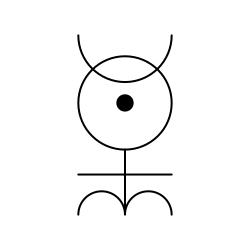
Monas Hieroglyphica
Symbolic Profile
Primary Name: Monas Hieroglyphica (The Hieroglyphic Monad)
Common Aliases: The Hieroglyphic Monad, Monas, Dee's Monad, The Glyph of Hermes, The Universal Hieroglyph, The Seal of Hermes, The Sacred Monad of Dr. John Dee, The Cosmological Monad
Visual Core (the baseline shape): A composite Hermetic glyph comprising a lunar crescent seated atop a solar circle with a central point, supported by an equal-armed cross that terminates at its base in the two joined semicircles of the zodiacal sign Aries
Exoteric Keywords (surface meaning): Unity, synthesis, astronomy, alchemy, Hermeticism, sacred geometry, planetary harmony, divine proportions, written cosmos
Esoteric Keywords (occult meaning): The Monad (Primary Unity), Magnum Opus, Rebis (Hermetic Androgyne), Solve et Coagula, Universal Mercury, Cabbalistic Tetraktys, Astral Light, Axis Mundi, Integration of the Self
Astrological or Planetary links: Mercury (☿, Central Synthesis), The Sun (☉, Solar Circle), The Moon (☽, Lunar Crescent), Aries (♈, Foundation Fire), The Seven Planetary Spheres integrated into a single unified emblem
Alchemical Associations: Universal Mercury, Prima Materia, Lapidification, Conjunction of Sol and Luna, Elemental Fire of Aries (Ignis), Rebis (Divine Hermaphrodite), The Completed Magnum Opus
Associated Metals: Quicksilver (Mercury - fluid spirit), Gold (Sun - divine intellect), Silver (Moon - reflective soul), Iron (Mars/Aries - active fire), Lead (Saturn - foundational cross)
Traditional Colours: Gold (Solar core), Silver (Lunar crest), Obsidian Black (Nigredo), Pure White (Albedo), Crimson Red (Rubedo), Emerald Green (Hermetic Emerald Tablet)
Form and Origin
Natural or Material Inspiration
Inspired by the observed movements of celestial bodies, the anatomical structure of the eye and seed, the geometric harmony of nature, and the traditional astronomical sigils of the Renaissance. John Dee conceived the Monas not as an arbitrary human invention, but as an anatomical diagram of the cosmos—a discovery of the intrinsic graphic syntax through which God inscribed the universe into existence.
Geometric Philosophy
Represents the ultimate synthesis of point, line, circle, cross, and crescent. In Dee's sacred geometry, the glyph begins with the central point (Bindu or Monad), expands into the solar circle (representing eternity and spirit), is crowned by the lunar crescent (representing receptivity and flux), stands upon the fourfold cross of the elements (representing physical manifestation), and rests upon the twin arcs of Aries (representing primal fire and the rotation of the zodiac). Mathematically, it encodes the Pythagorean Tetraktys (1 + 2 + 3 + 4 = 10), reconciling unity and multiplicity.
Historical Evolution of the Form
Designed and published by the English mathematician, astrologer, and Hermetic philosopher Dr. John Dee in his 1564 treatise Monas Hieroglyphica, written in twelve days at Antwerp and dedicated to Holy Roman Emperor Maximilian II. The emblem evolved out of Renaissance Agrippan magic, Paracelsian alchemy, and Alexandrian Hermeticism. It subsequently became a central symbol of the 17th-century Rosicrucian enlightenment, appearing prominently in the Chymical Wedding of Christian Rosenkreutz (1616) and influencing European esoteric iconography for centuries.
Mythological and Cultural Context
The Origin Point
Emerging during the height of the Northern Renaissance in 1564, the Monas Hieroglyphica was presented by John Dee as an illuminated key to all arts and sciences—astronomy, cabbalah, alchemy, mathematics, and linguistics. Dee asserted that the glyph was revealed through divine intellectual light, serving as a universal visual language (Character or real character) capable of uniting all divided human knowledge into a single divine science.
Cultural Migration
From Elizabethan England and the Holy Roman Empire, the Monas migrated rapidly through European esoteric circles. It was adopted by the early Rosicrucians in Germany as a graphic proof of the Rebis or perfected alchemical human. In the 18th and 19th centuries, it was integrated into high-degree Masonic lore, Martinism, and Hermetic Qabalah, eventually being studied by the Hermetic Order of the Golden Dawn and modern occult scholars as the definitive emblem of Hermetic synthesis.
Folklore and Ritual Use
While not used in common folk magic, the Monas Hieroglyphica served as a supreme talismanic emblem in elite ceremonial magic and alchemical contemplation. Hermetic practitioners engraved the glyph onto talismans of lead, silver, and gold to invoke planetary equilibrium, used it as a meditative focus for alchemical labor (Laboratorium et Oratorium), and incorporated it into mathematical-magical seals designed to commune with angelic intelligences.
Esoteric and Psychological Depths
Jungian Archetypes
In analytical psychology, Carl Jung recognized the Monas Hieroglyphica as a profound archetypal image of the Self and the Coniunctio Oppositorum (Sacred Marriage of Opposites). The glyph integrates the masculine solar principle (Sol) and feminine lunar principle (Luna) over the fourfold cross of physical reality, anchored by the fiery instinctual drive of Aries. It represents the psyche's spontaneous capacity to synthesize conscious awareness and unconscious instinct into a unified, self-regulating totality.
Occult and Mystical Usage
In Hermetic Cabbalah, the Monas functions as a map of divine emanation. The upper crescent and circle correspond to the Supernal Triad (Kether, Chokmah, Binah), the cross represents the six Sephiroth of Microprosopus (Chesed through Yesod), and the base of Aries represents Malkuth transformed by spiritual fire. Operationally, it is used in pathworking and meditation to trace the descent of divine spirit into matter and the spiritual ascent of the alchemist back to the divine source.
Dream Symbology
Dreaming of the Monas Hieroglyphica or its composite components signifies an impending spiritual breakthrough, the resolution of deep psychological dualities, or the awakening of universal synthesis within the dreamer's life. It indicates that opposing forces—logic and intuition, light and shadow, spirit and body—are coming into dynamic alignment to forge an unshakeable inner center.
Themes and Pairings
Core Thematic Associations
Universal synthesis, cosmic order, the reconciliation of opposites, Hermetic alchemy, Cabbalistic numerical harmony, the unity of science and magic, the Magnum Opus, and the spiritualized intellect.
Traditional Pairings
The Emerald Tablet of Hermes (Tabula Smaragdina), The Pythagorean Tetraktys, The Philosopher's Stone (Lapis Philosophorum), The Rosicrucian Rose Cross, and The Archangel Uriel/Gabriel.
Contrasting Symbols
The Massa Confusa (Unrefined chaotic matter), The Broken Vector / Disjointed Lines (Fragmentation and disunity), and Profane Secular Materialism (Matter divorced from spiritual origin).
Quotations
"The Sun and the Moon of this Monad desire that the Elements in which the tenth proportion will flourish shall be separated through the agency of FIRE... By this glyph, Hermes reveals to us that the whole cosmic art is contained in Unity, Binary, Ternary, and Quaternary."
John Dee, Monas Hieroglyphica (Theorem X & XVI), 1564
"John Dee's Monas Hieroglyphica is the most concentrated visual summary of the Hermetic tradition ever devised—a single symbol wherein astronomy, alchemy, cabbalah, and geometry converge to reveal the anatomy of the cosmos."
Gareth Knight, A Practical Guide to Qabalistic Symbolism, 1965
"The Monas Hieroglyphica of John Dee is an exemplary image of the Self, portraying through geometrical synthesis the union of the solar conscious ego with the lunar unconscious, grounded upon the quaternary cross of reality."
Carl Gustav Jung, Mysterium Coniunctionis (Collected Works, Vol. 14), 1956
Reference Library
Notable Masterworks
- Monas Hieroglyphica Title Page Woodcut — Dr. John Dee & Willem Silvius (1564, Antwerp Edition, British Library)
- The Chymical Wedding of Christian Rosenkreutz — Johann Valentin Andreae (1616, Title Page and Text Illustrations)
- Amphitheatrum Sapientiae Aeternae (Engravings) — Heinrich Khunrath (1595, Featuring Dee's Monas iconography)
- Rosicrucian Emblems of the Secret Symbols — Altona Edition (1785, Hermetic-Alchemical Diagrams)
Primary Texts
- Dr. John Dee: Monas Hieroglyphica (The Hieroglyphic Monad, 1564, Translated by C.H. Josten / J.W. Hamilton-Jones)
- Heinrich Cornelius Agrippa: Three Books of Occult Philosophy (De Occulta Philosophia, 1533, Book II)
- Frances A. Yates: The Rosicrucian Enlightenment (Chapter IV: 'John Dee and the Rosicrucian Movement')