

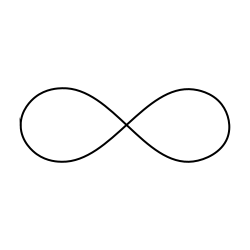
Leminscate
Symbolic Profile
Primary Name: Lemniscate (Lemniscus / Infinity Symbol)
Common Aliases: Infinity Symbol, Horizontal Figure Eight, Lemniscus (Ribbon), Curve of Bernoulli, The Magician's Brim/Aureole, Ribbon of Eternity, Knot of Infinity, Loop of Perpetual Motion, Double Loop of the Cosmic Breath
Visual Core (the baseline shape): A continuous, unicursal plane curve consisting of two identical, symmetrical loops meeting at a central focal node (intersection point), forming a horizontal figure-eight ($\infty$)
Exoteric Keywords (surface meaning): Infinity, endlessness, balance, eternal continuity, cyclical recurrence, equilibrium, mathematical boundlessness, feedback loop, eternal movement
Esoteric Keywords (occult meaning): The Magician (Tarot Key 1), Cosmic Breath (Prana / Inhalation and Expiration), Solve et Coagula, Circulation of Astral Light, Astral Caduceus Node, Rhythm of the Universe, Reconciled Duality, Transfinite Monad
Astrological or Planetary links: Mercury (☿, Mental Mastery / Magus), Leo (♌, Solar Heart / Strength), Uranus (♅, Transfinite Infinite Potential), Lunar Nodal Axis (Head and Tail of the Dragon)
Alchemical Associations: Circulatio / Distillatio, Ouroboros twisted into a double loop, Fluidity of Quicksilver (Mercury), Balancing of Opposites across the Central Node, Hermetic Axiom of As Above, So Below
Associated Metals: Quicksilver (Mercury - continuous circulation), Gold (Sun), Platinum, Electrum
Traditional Colours: Iridescent White, Metallic Silver, Pure Gold, Celestial Blue / Cosmic Indigo, Transparent Crystal
Form and Origin
Natural or Material Inspiration
Inspired by the visual path of a swinging pendulum, the rhythmic figure-eight motion of bird wingbeats in hovering flight, the double-lobed magnetic fields surrounding celestial and planetary bodies, the twisted coiling of serpentine currents (as seen in the Caduceus), and the fluid dynamics of vortex motion in air and water currents.
Geometric Philosophy
Represents the ultimate dynamic geometry of infinite circulation and continuous self-balance. Unlike the static circle, which encloses space around a single center, the lemniscate generates two opposing polar spaces that continuously exchange energy across a single, central crossover point (focal node). It embodies the principle of dynamic balance—demonstrating that true unity is not a fixed immobility, but a perpetual, frictionless movement between dual polarities (masculine and feminine, spirit and matter, inhalation and expiration).
Historical Evolution of the Form
Rooted anciently in the Roman lemniscus (a hanging ribbon or garland tied to victors) and the coiled serpentine figure-eights found on ancient Gnostic amulets, Egyptian Caduceus staffs, and Celtic knotwork. It was formally introduced into modern mathematics as the symbol for infinity ($\infty$) by the English mathematician John Wallis in his 1555 treatise De Sectionibus Conicis. Jakob Bernoulli mathematically defined the algebraic "Lemniscate of Bernoulli" in 1694. In esoteric iconography, it gained central prominence through the 18th- and 19th-century Tarot tradition—appearing above the head of The Magician (Key 1) and Strength (Key 8) in the Marseille and Waite-Smith decks as the emblem of spiritual mastery over material forces.
Mythological and Cultural Context
The Origin Point
Emerging at the intersection of classical Roman honors (lemniscus ribbons symbolizing victory and immortality), ancient serpentine symbolism (the Ouroboros twisted at its midpoint), and 17th-century mathematical notation for the transfinite. Wallis chose the figure-eight shape likely as a variation of the Roman numeral for 1,000 ($\text{CI}\supset$ or $\infty$) or as an evolved variant of the closed Ouroboros ring signifying endless counting.
Cultural Migration
Migrated from 17th-century mathematical notation into 18th- and 19th-century Western ceremonial magic and Tarot symbolism. French occultists such as Éliphas Lévi and later Arthur Edward Waite explicitly identified the horizontal figure-eight above the Magician's head as the Nimbus of Life or the Holy Spirit's Aureole, signifying the mastery of the divine intellect over the lower astral currents. In Eastern traditions, the lemniscate maps closely to the Tibetan Endless Knot (Srivatsa) and the double-loop flow of Prana through the Ida and Pingala nadis crossing the central Sushumna axis.
Folklore and Ritual Use
Applied in modern ritual magic, sacred movement, and energy work as a tracing gesture (drawing the lemniscate in the air) to balance opposing energetic polarities, harmonize the left and right hemispheres of the brain, seal protective boundaries, and induce states of rhythmic meditation. It is frequently carved into talismans and wedding bands as an oath of immortal, undying love and infinite soul connection.
Esoteric and Psychological Depths
Jungian Archetypes
In analytical psychology, the lemniscate maps directly to the archetype of Enantiodromia—the psychological principle that superabundance of any force inevitably produces its opposite, generating a rhythmic oscillation between polar states. Carl Jung recognized the figure-eight loop as a symbol of the continuous dialogue between the conscious Ego and the unconscious Shadow, where psychic energy (libido) flows back and forth across the central node of the Self to maintain psychological equilibrium and prevent stagnation.
Occult and Mystical Usage
Central to Hermeticism and Tarot symbolism as the emblem of mental control over raw force. On Tarot Key 1 (The Magician), the lemniscate floating above the initiate's head represents the unbounded, limitless power of the Divine Mind acting through human consciousness—the capacity to draw divine energy from above and direct it into manifestation below. On Tarot Key 8 (Strength), the lemniscate hovering above the woman's head signifies spiritual gentleness and mental poise taming the lion of wild instinctual force without violence. In Qabalah, it represents the rhythmic circulation of energy along the paths of the Tree of Life and the infinite light of Ain Soph manifesting through the central pillar.
Dream Symbology
Dreaming of a lemniscate or an infinite figure-eight loop symbolizes the resolution of dualistic conflicts, the discovery of inner balance between opposing choices, or the realization of unbounded personal potential. It indicates that the dreamer is entering a phase of continuous self-renewal where apparent contradictions (work and rest, intellect and emotion, give and take) are being synthesized into a harmonious flow.
Themes and Pairings
Core Thematic Associations
Infinite continuity, dynamic equilibrium, rhythmic alternation, the reconciliation of dualities, the flow of astral light, mental mastery over physical force, perpetual self-renewal, and the Hermetic axiom of As Above, So Below.
Traditional Pairings
The Magician (Tarot Key 1), Strength (Tarot Key 8), The Caduceus of Hermes, The Ouroboros (in double-loop form), The Wand / Caduceus, and The Endless Knot.
Contrasting Symbols
The Broken Line / Severed Vector (Interrupted flow and finite destruction), The Rigid Square (Static terrestrial confinement without circulation), and Chaos / Undirected Turbulence (Movement without a central balancing node).
Quotations
"Above his head is the mysterious sign of the Holy Spirit, the sign of life, possessing the figure of a horizontal 8 ($\infty$), which is the emblem of infinity and the divine intellect."
Arthur Edward Waite, The Pictorial Key to the Tarot (1910, Discussion of Key 1: The Magician)
"The lemniscate represents the rhythm of the universe—the eternal back-and-forth movement between spirit and matter, light and shadow, inhalation and expiration, through which the cosmos maintains its living equilibrium."
Gareth Knight, A Practical Guide to Qabalistic Symbolism (1965, Ch. 5)
"Energy flows perpetually between opposites in an infinite rhythm, just as the figure-eight loop continuously returns to its origin through the central point of transformation."
Carl Gustav Jung, Symbols of Transformation (Collected Works, Vol. 5, 1952)
Reference Library
Notable Masterworks
- The Magician (Tarot Key I) — Pamela Colman Smith & Arthur Edward Waite (1909, Rider-Waite-Smith Tarot Deck)
- Strength (Tarot Key VIII) — Pamela Colman Smith & Arthur Edward Waite (1909, Rider-Waite-Smith Tarot Deck)
- De Sectionibus Conicis (Treatise on Conic Sections) — John Wallis (1655, First printed appearance of $\infty$)
- The Caduceus / Hermetic Emerald Tablet Engravings — Heinrich Khunrath & Johann Theodor de Bry (1602, Amphitheatrum Sapientiae Aeternae)
Primary Texts
- John Wallis: De Sectionibus Conicis (1655, Mathematical introduction of the infinity symbol $\infty$)
- Éliphas Lévi: Dogme et Rituel de la Haute Magie (1854, Discussion of the Magus hat and the circulation of the Astral Light)
- Arthur Edward Waite: The Pictorial Key to the Tarot (1910, Detailed esoteric commentary on the lemniscate in Tarot Keys 1 and 8)