

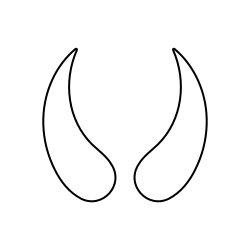
Horns
Symbolic Profile
Primary Name: Horns (Cornua / Horns of Consecration)
Common Aliases: Cornua, Horns of Consecration, Crescent Horns, Solar-Lunar Horns, The Horned Crown, Caput Cornutum, Horns of Power, Cornucopia (Horn of Plenty)
Visual Core (the baseline shape): Two pointed, upward-curving crescent appendages projecting symmetrically from the crown of the head or a central altar, forming an open crescent arc reaching toward the sky
Exoteric Keywords (surface meaning): Power, strength, defense, aggression, bull, stag, ram, royalty, drinking horn, horn of plenty, warning
Esoteric Keywords (occult meaning): Divine Radiance (Karan / Rays of Light), Masculine Generative Force / Solar-Lunar Balance, Consecrated Altar (Horns of the Altar), Apex of Vital Force, Opening of the Path, Sovereign Elevation, Chthonic-Celestial Gateway
Astrological or Planetary links: Taurus (♉, Bull Horns / Earthly Vitality), Aries (♈, Ram Horns / Solar Fire), Moon (☽, Crescent Horns / Lunar Tides), Sun (☉, Rays of Light / Crown of Sol), Mars (♂, Martial Strength & Defense)
Alchemical Associations: Fixation of Volatiles, Alchemical Salt / Sulphur Projection, The Horned Vessel (Vas Hermeticum with dual spouts), Transmutation of Animal Instinct into Spiritual Power
Associated Metals: Bronze (Bronze Age Helmet Horns & Altar Horns), Iron (Martial Strength), Gold (Solar Crown of Rays / Golden Horns)
Traditional Colours: Crimson Red (Fiery Vitality & Blood), Solar Gold (Divine Light), Midnight Black (Chthonic Underworld / Cernunnos), Pure White (Lunar Crescent / Consecrated Altar)
Form and Origin
Natural or Material Inspiration
The symbol of horns derives directly from the permanent calcified or keratinous cranial growths of horned animals—most notably bulls, stags, rams, goats, and antelopes. To early pastoral and hunting societies, horns represented the natural animal kingdom's most formidable weapons of defense, territory maintenance, and physical supremacy. Unlike shed antlers or fragile hide, horns grow continuously toward the sky, embodying an unbreakable surge of life-force, defensive strength, and biological vitality anchored directly to the crown of the animal.
Geometric Philosophy
Geometrically, horns present a dual upward-curving crescent form radiating symmetrically from a single central head or altar base. Each horn forms an open parabolic arc or spiral vector that tapers from a broad, sturdy base to an acute, penetrating apex. In sacred geometry, horns synthesize the linear vector (representing directional force, penetration, and masculine projection) with the crescent arc (representing receptive containment, lunar tides, and open space). The space defined between two horns creates a consecrated parabolic vessel or golden threshold that captures and focuses divine radiation descending from the cosmos.
Historical Evolution of the Form
The visual iconography of horns evolved from Paleolithic shamanic headdresses (such as the stag-antlered masks of Star Carr, c. 9000 BCE) into the Minoan "Horns of Consecration" at Knossos and Neolithic bull shrines at Çatalhöyük. In ancient Mesopotamia and Egypt, horned crowns signified supreme divinity, worn by gods such as Enlil, Marduk, Hathor, and Isis. In classical antiquity, Alexander the Great was depicted on coins with the ram horns of Ammon (becoming Dhu al-Qarnayn, "The Two-Horned One"). In Celtic and Germanic Europe, horned deities (such as Cernunnos) and horned ritual helmets (such as the Waterloo Helmet) embodied sacred wilderness, martial prestige, and spiritual sovereignty, later influencing Christian iconography of the altar and medieval Hermetic art.
Mythological and Cultural Context
The Origin Point
Horns emerged as supreme symbols of divinity and sacred power in the earliest agricultural and hunting cultures of the Near East, Europe, and Africa. In the Neolithic settlement of Çatalhöyük (c. 7000 BCE), bull skulls (bucrania) and molded horns were embedded into temple walls to anchor sacred protective energy. In Bronze Age Crete, the Minoan Horns of Consecration marked the boundaries of altars, palace rooftops, and sacred mountain peaks, establishing a ritual precinct where terrestrial offerings met celestial blessing.
Cultural Migration
Across global civilizations, horns functioned as universal emblems of royal authority, divine favor, and cosmological balance. In ancient Egypt, the goddess Hathor and Isis were depicted wearing solar disks cradled between two upward-curving cow horns, symbolizing the cosmic womb nurturing the sun. In Judeo-Christian tradition, the Horns of the Altar (Exodus 27:2) offered sacred sanctuary to those who touched them, while the mistranslation of the Hebrew word karan ("shone/radiated rays of light") in the Latin Vulgate led to St. Jerome rendering Moses with horned rays upon descending Sinai. In Celtic mythology, Cernunnos—the horned god of animals, forests, and wealth—was depicted cross-legged holding a torc and a horned serpent, representing the harmony between wild nature and spiritual abundance.
Folklore and Ritual Use
In folk traditions and ritual practice, horns were deployed as apotropaic instruments of protection, purification, and celebratory communion. Drinking horns carved from bull or ram horns were used during solemn toasts, oath-taking ceremonies, and royal feasts to seal covenants. Musical horns (lur, shofar, ram's horn) were blown to announce sacred assemblies, sound martial charges, drive away malignant spirits, and herald the New Year (Rosh Hashanah). In Italian and Mediterranean folk magic, the cornicello (twisted horn amulet) remains one of the most popular talismans worn to ward off the evil eye (malocchio) and ensure fertility.
Esoteric and Psychological Depths
Jungian Archetypes
In analytical psychology, horns embody the archetype of the Primal Instinctive Energy and Sublime Elevation. Carl Jung noted that horns symbolize the upward surge of libidinous vital force (élan vital) from the subconscious depths into conscious awareness. Representing both animal drive and divine illumination, horns map the psychological process wherein raw, untamed instinctual energy is not repressed, but sublimated and crowned at the highest apex of personality (the head), transforming primitive aggression into creative spiritual power.
Occult and Mystical Usage
In Hermetic Qabalah, ceremonial magic, and Neopagan traditions, horns represent the operational synthesis of active force and receptive form. On the Tree of Life, horned iconography aligns with Chokmah (Wisdom / Dynamic Masculine Force) and Kether (The Crown / Divine Apex), as well as the path connecting the material world to higher spheres. In alchemical operations, the horned vessel (Vas Hermeticum) represents the dual spouts through which volatile spirits are circulated (Rotatio) and fixed. In modern Wicca and Western Mystery traditions, the Horned God represents the active masculine principle of nature, complementing the Triple Goddess of the Moon.
Dream Symbology
Dreaming of horns signifies an awakening of dormant personal power, heightened intuition, and the emergence of strong protective boundaries. Growing horns in a dream indicates rising self-assertion, leadership capacity, and spiritual elevation. Encountering a horned deity or animal (such as a white stag or bull) portends an encounter with the wild, uncorrupted wisdom of the instinctual Self. Conversely, being attacked by horned beasts warns of unintegrated aggression, suppressed anger, or an ongoing conflict between civilized intellect and primitive desires.
Themes and Pairings
Core Thematic Associations
The primary themes embodied by horns are divine radiance, instinctual vitality, sovereign authority, sacred sanctuary (horns of the altar), masculine generative force, solar-lunar synthesis, defense and territorial protection, and the gateway between terrestrial nature and celestial light.
Traditional Pairings
Horns are traditionally paired with the Solar Disk (cradled between cow horns), the Crescent Moon (reflecting lunar curvature), the Altar / Sanctuary (Horns of the Altar), the Torc or Sacred Ring, the Serpent (forming the Horned Serpent), the Crown / Diadem, and the Cornucopia (Horn of Plenty filled with grain and fruit).
Contrasting Symbols
The direct polar opposites of horns are the Smooth Sphere / Featureless Dome (representing passive, unprojected potential without directional points), the Severed Stem / Truncated Stump (representing loss of vitality and severed connection), and the Broken Reed (representing fragility and lack of defensive structure).
Quotations
"All primitive traditions prove that the horn is a symbol of strength and power... In Egyptian hieroglyphs, the sign of the horn indicates 'what is above the head' and, by extension, 'to open up a path for oneself.' The horn is a dual symbol: from one point of view it is penetrating in shape, and therefore active and masculine; and from the other, it is shaped like a receptacle, which is feminine in meaning."
J. E. Cirlot, A Dictionary of Symbols, 1962
"The Horned God is the oldest of the gods of Western Europe, representing virility, the wild hunt, the forest, and the cycle of nature... His horns are both the branches of the sacred tree and the crescent moon, linking the terrestrial soil to the movement of the cosmos."
Miranda Aldhouse-Green, Celtic Art: Symbols and Imagery, 1996
"When Moses came down from Mount Sinai with the two tables of testimony, his face shone with rays of light—translated in the Latin Vulgate as 'cornuta' or horned—for the horn is the universal emblem of divine illumination, spiritual elevation, and sovereign power."
Ralph M. Lewis, Behold the Sign: Ancient Symbolism, 1944
Reference Library
Notable Masterworks
- Minoan Horns of Consecration — Bronze Age Sacred Architecture (c. 1900–1400 BCE, Palace of Knossos, Crete)
- Cernunnos on the Gundestrup Cauldron — Celtic Silver Masterwork (c. 1st Century BCE, National Museum of Denmark, Copenhagen)
- Statue of Moses (Featuring Horned Rays of Light) — Michelangelo (c. 1513–1515, San Pietro in Vincoli, Rome)
- The Waterloo Helmet (Horned Bronze Ceremonial Helmet) — Celtic Iron Age Artifact (c. 150–50 BCE, British Museum, London)
- Silver Tetradrachm of Alexander the Great with Ram Horns of Ammon — Hellenistic Coinage (c. 305–281 BCE, Lysimachus Mint)
Primary Texts
- The Book of Exodus (Chapter 27: The Horns of the Altar & Chapter 34: The Shining/Horned Face of Moses)
- J. E. Cirlot: A Dictionary of Symbols (Entry on "Horns", 1962)
- Miranda Aldhouse-Green: Celtic Art: Symbols and Imagery (Chapter 5: "Cult of the Horned God and Animal Deities")