

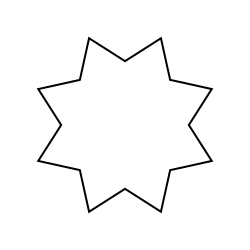
Eight Pointed Star
Symbolic Profile
Primary Name: Eight-Pointed Star
Common Aliases: Octagram, Star of Ishtar / Inanna, Rub el Hizb, Khatim Sulayman (Eight-Pointed Seal of Solomon), Star of Venus, Ogdoad Star, Eight-Rayed Star, Star of Redemption, Eight-Point Compass Rose
Visual Core (the baseline shape): An eight-pointed star formed by two overlapping congruent squares rotated at 45 degrees, or by eight interlocking diagonal rays radiating symmetrically at 45-degree intervals from a central hub
Exoteric Keywords (surface meaning): Direction, compass, navigation, cosmic order, protection, symmetry, harmony, renewal, eight directions, balance
Esoteric Keywords (occult meaning): The Ogdoad (Primordial Eight of Hermopolis), Star of Ishtar/Venus (Morning & Evening Star), Regeneration / Resurrection (The 8th Day / Octave), Rub el Hizb (Quranic Division Marker), Balance of Spirit and Matter (Interlocking Squares), Intermediate Directions, Cosmic Axis, Pathway to Transmutation
Astrological or Planetary links: Venus (♀, 8-year synodic cycle with the Sun; Star of Ishtar), The Seven Planets plus the Eighth Sphere of Fixed Stars (The Ogdoad), Uranus (Outer Synthesis & Higher Intellect)
Alchemical Associations: The Ogdoad / Eightfold Path of Transmutation, Conjunction of Earthly Matter (Square) and Heavenly Order (Rotated Square), Regeneration through the 8th Fire, Fixation of the Eight Winds
Associated Metals: Copper (Venus / Ishtar), Electrum, Silver-Gold Alloy
Traditional Colours: Luminous Gold, Royal Blue, Emerald Green (Islamic Rub el Hizb), Crimson Red (Ishtar / Venus war and love)
Form and Origin
Natural or Material Inspiration
Inspired by the 8-year orbital cycle of the planet Venus as observed from Earth, the appearance of bright eight-rayed optical diffraction patterns around brilliant celestial bodies, the eight-point compass rose reflecting the principal and half-winds of the horizon, the natural eightfold radial symmetry of flowers (such as the lotus and lily), and the crystalline geometry of octagonal minerals (such as fluorite and garnet).
Geometric Philosophy
Geometrically, the octogram is constructed either by interlacing two congruent squares rotated 45 degrees relative to each other (the Rub el Hizb or Khatim) or by extending eight lines from the vertices of a regular octagon to its central axis. The square represents static terrestrial physical reality (the four elements and four cardinal directions); by superimposing a second square at 45 degrees, static matter is activated into dynamic cosmic rotation. In sacred geometry, eight represents the Octave, the threshold of regeneration, and the bridge between the square (Earth / 4) and the circle (Heaven / 1).
Historical Evolution of the Form
The octogram is one of humanity's oldest astronomical and theological glyphs, originating in ancient Sumer and Akkad (c. 3000 BCE) as the cuneiform ideogram Dingir (meaning "deity" or "heaven") and the divine attribute of Inanna/Ishtar. In pharaonic and Hellenistic Egypt, it represented the Ogdoad of Hermopolis—four pairs of primordial deities representing the chaotic elements before creation. It migrated into Islamic sacred architecture and Quranic calligraphy as the Rub el Hizb (۞), into Christian baptisteries and iconography as the 8th Day of Resurrection, and into heraldry and maritime navigation as the eight-wind compass rose.
Mythological and Cultural Context
The Origin Point
Originating in ancient Mesopotamia during the Uruk and Early Dynastic periods, the eight-pointed star was the primary emblem of Inanna (Ishtar), goddess of love, war, fertility, and the planet Venus. In cuneiform script, the eight-rayed star Dingir was prefixed to the names of gods to signify divinity, star-light, and cosmic authority.
Cultural Migration
As sacred geometry traveled across the Mediterranean and Near East, the octogram assumed profound religious and architectural roles. In Islamic art, the two interlocking squares formed the Rub el Hizb, used to mark recitations of the Quran and to structure intricate tile mosaics (zellige) across Moorish Spain and North Africa. In Christian tradition, eight became the number of resurrection and grace—the "Eighth Day" beyond the seven days of creation—leading to octagonal baptismal fonts and church domes (such as the Dome of the Rock and Charlemagne's Palatine Chapel). In Native American and Scandinavian traditions, the eight-pointed star appeared in weaving and compass dials (Vegvísir variants) as a symbol of guidance and protection.
Folklore and Ritual Use
In folk magic and ritual practice, the octogram functions as an apotropaic seal of protection and directional alignment. In Islamic calligraphic talismans, the Khatim Sulayman (eight-pointed Seal of Solomon) was inscribed on doors, amulets, and ring-stones to bind spirits and ward off the evil eye. In maritime folklore, sailors tattooed the eight-pointed compass rose upon their forearms to ensure safe return through shifting winds. In Western ceremonial magic, the eight-pointed star is deployed to invoke the planetary forces of Venus and the Hermetic Ogdoad.
Esoteric and Psychological Depths
Jungian Archetypes
In analytical psychology, the octogram embodies the archetype of Quaternary Expansion and Psychic Rebirth. Building upon the basic fourfold quaternity of the ego's cognitive functions (Thinking, Feeling, Sensation, Intuition), the eight-pointed star represents the doubling of the quaternity into an integrated eightfold mandala. It maps the transition from basic ego-orientation to a higher, multi-dimensional synthesis of the Self, where conscious and unconscious polarities are harmonized across all directions.
Occult and Mystical Usage
In Hermeticism, Gnosticism, and Qabalah, the octogram corresponds to the Ogdoad—the eight primordial forces of creation—and the 8th Sephira Hod (Splendor / Intellect) when balanced by Netzach (Victory / Emotion) on the Tree of Life. In Tarot, Key 17, The Star, features a prominent eight-pointed golden star surrounded by seven smaller eight-pointed stars, symbolizing divine hope, meditation, and the pouring of living waters from the cosmic vessel. In alchemical mysticism, the octogram signifies the completion of the eightfold path of transmutation and the emergence of the spiritualized body (Corpus Glorificationis).
Dream Symbology
Dreaming of a shining eight-pointed star signifies spiritual guidance, incoming hope, emotional renewal, and the stabilization of life path choices after a period of disorientation. It indicates that the dreamer's internal compass is aligning with higher purpose. An expanding or rotating octogram in a dream portends a creative breakthrough, the harmonious resolution of complex life dilemmas, and the opening of new perceptual horizons.
Themes and Pairings
Core Thematic Associations
The primary themes embodied by the octogram are cosmic regeneration, divine guidance, the eighth day of resurrection, directional alignment, the Venusian cycle of love and war, the balance of spirit and matter through dual squares, and Hermetic completeness (Ogdoad).
Traditional Pairings
The octogram is traditionally paired with the Crescent Moon (Ishtar / Sin pairing), the Compass Rose, the Octagon (Architecture of initiation), the Star of Bethlehem, Tarot Key 17 (The Star), the Rose of Venus, and the Rub el Hizb / Khatim Sulayman.
Contrasting Symbols
The direct polar opposites of the octogram are the Unstructured Chaos / Asymmetrical Point Cloud (representing lack of directional guidance and entropy), the Single Static Line (representing narrow, one-dimensional progress), and the Broken / Fractured Polygon (representing spiritual disorientation).
Quotations
"The eight-pointed star, or octagram, was the ancient symbol of the goddess Inanna-Ishtar in Mesopotamia, representing the planet Venus in both her morning and evening aspects as the star of love and war."
Adele Nozedar, The Element Encyclopedia of Secret Signs and Symbols, 2008
"Eight is the number of baptism, rebirth, and resurrection. For as the world was created in seven days, the eighth day represents the eternal kingdom of grace... Hence baptismal fonts from antiquity to the Middle Ages are almost universally octagonal."
Ralph M. Lewis, Behold the Sign: Ancient Symbolism, 1944
"The Ogdoad consists of four pairs of balanced male and female principles, representing the primordial chaos before creation... The eight-pointed star stands as the graphic glyph of this complete cosmic order."
Gareth Knight, A Practical Guide to Qabalistic Symbolism, 1965
Reference Library
Notable Masterworks
- Star of Ishtar Boundary Stone (Kudurru of Meli-Shipak II) — Babylonian Carving (c. 12th Century BCE, Louvre Museum, Paris)
- Zellige Mosaics and Ceiling of the Alhambra (Rub el Hizb Patterns) — Moorish Islamic Architecture (14th Century, Granada, Spain)
- Palatine Chapel Octagonal Dome & Font — Carolingian Architecture (c. 800 CE, Aachen Cathedral, Germany)
- The Star (Tarot Key XVII Card Art) — Pamela Colman Smith & A.E. Waite (1909, Rider-Waite Tarot Deck)
Primary Texts
- The Descent of Inanna (Sumerian Mythological Epic featuring the eight-pointed Star of Ishtar)
- Pseudo-Dionysius: The Celestial Hierarchy (On the orders of spiritual light and sacred geometry)
- Gareth Knight: A Practical Guide to Qabalistic Symbolism (Section on the Number Eight and the Ogdoad)