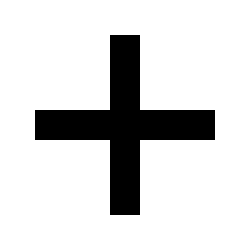
Equal-Armed Cross
Symbolic Profile
Primary Name: Equal-Armed Cross
Common Aliases: Greek Cross, Crux Quadrata, Fourfold Axis, Solar Cross (when enclosed in a circle), Cross of the Four Elements, Tetradic Cross, Cross of Earth and Sky, Balance Cross
Visual Core (the baseline shape): Two straight lines of equal length intersecting at right angles (90 degrees) at their exact midpoints, forming four equal arms radiating from a central point
Exoteric Keywords (surface meaning): Balance, equality, four directions, cardinal points, four seasons, intersection, harmony, stabilization, structure, crossroad
Esoteric Keywords (occult meaning): Quaternary Manifestation, Equilibrium of the Four Elements (Fire, Water, Air, Earth), Microcosmic Center, Synthesis of Opposites, Malkuth / Earth Plane, Crucible of Materialization, Fourfold Tetragrammaton, Middle Way
Astrological or Planetary links: Earth (🜃 / ⊕), The Four Cardinal Signs (Aries, Cancer, Libra, Capricorn) / Four Fixed Signs (Taurus, Leo, Scorpio, Aquarius), Sun Cross (☉/⊕), Four Quarters of the Wheel of the Year
Alchemical Associations: The Four Elements (Fire, Water, Air, Earth), The Crucible / Fixation of Volatiles, Equilibrium of Salt, Sulphur, and Mercury within the Material Quaternary, Alchemical Earth Symbol
Associated Metals: Iron (Mars / Central Intersection), Copper (Venus / Harmony of Elements), Lead (Saturn / Material Structure)
Traditional Colours: Red (Fire / East), Blue (Water / West), Yellow (Air / South), Green / Black (Earth / North); White at the central intersection point
Form and Origin
Natural or Material Inspiration
The form of the equal-armed cross is inspired by the primary spatial and temporal coordinates observed in the physical world. Its most immediate natural reference is the division of the horizon into four cardinal directions—North, South, East, and West—established by the human body standing upright facing the rising sun. Materially, it mirrors the intersection of two crossed fire-sticks (arani) used in antiquity to kindle sacred fire, the alignment of two intersecting logs forming shelter structures, the natural fourfold symmetry of crystalline formations, and the four seasonal shifts of the solar year marked by solstices and equinoxes.
Geometric Philosophy
Geometrically, the equal-armed cross is created by the orthogonal intersection of two equal line segments at their exact midpoints. The vertical line symbolizes the active, masculine, spiritual axis connecting heaven and earth, while the horizontal line symbolizes the passive, feminine, material plane extending across space. Their intersection at right angles forms four 90-degree corners, totaling 360 degrees—the geometric equivalent of the circle. In sacred geometry, the equal-armed cross represents the transition from the unmanifest spiritual realm to the structured physical quaternity, providing the invisible matrix from which the square and the cube are generated.
Historical Evolution of the Form
The visual history of the equal-armed cross extends into deep prehistory, appearing on Paleolithic bone carvings, Megalithic petroglyphs, and Neolithic pottery across Eurasia, the Americas, and Africa long before the advent of Christianity. In ancient Mesopotamia, it appeared as the ideogram for the sky-god Anu and the solar deity Shamash. In pre-Columbian America, it was venerated as the wind-rose of Tlaloc and Quetzalcoatl. In classical Greece, it was formalized as the Crux Quadrata (Greek Cross) and adopted by early Christian iconography as a primary emblem of universal redemption and cosmic harmony before the asymmetrical Latin cross became dominant.
Mythological and Cultural Context
The Origin Point
The equal-armed cross originated as an ancient cosmological diagram mapping the four quarters of the earth and sky. Archaeologically attested on 5th-millennium BCE Iranian ceramics, Bronze Age European sun disks, and pre-Dynastic Egyptian signs (such as the town ideogram Niwt), the symbol served to demarcate sacred order from primordial chaos. It marked the ritual center (omphalos) where divine energy descended to stabilize the material realm.
Cultural Migration
Across global traditions, the equal-armed cross evolved as a universal glyph for cosmic balance and territorial organization. In ancient China, it represented the five directions (four cardinal points plus the center) and the hing (five elements/agents). In Indigenous American traditions, such as the Dakota and Navajo cultures, it embodied the Four Winds and the medicine wheel. In Hermetic and Qabalistic traditions of Europe, it was synthesized into the Kabalistic Cross, the Rose Cross, and the fourfold elemental weapons, maintaining its function as the master blueprint of physical reality.
Folklore and Ritual Use
In folk traditions and ritual practice, the equal-armed cross is deployed as a powerful talisman of protection and balance. Farmers and villagers historically marked equal-armed crosses in whitewash, chalk, or salt upon doors, hearths, and four corners of fields to ward off storm demons, disease, and ill fortune. At physical crossroads—where two paths form an equal-armed intersection—rituals were performed to propitiate deities of thresholds, such as Hecate or Hermes. In ceremonial magic, tracing the four equal arms anchors consecrated space and establishes equilibrium among elemental forces.
Esoteric and Psychological Depths
Jungian Archetypes
In analytical psychology, Carl Jung identified the equal-armed cross as a primary archetype of the Quaternity—the psychological model of psychic completeness and order. Representing the four fundamental cognitive functions of the psyche (Thinking, Feeling, Sensation, and Intuition), the symmetrical cross functions as a natural mandala. It symbolizes the ego's center of gravity where opposing psychological polarities intersect and achieve equilibrium, preventing the personality from collapsing into chaotic unconsciousness.
Occult and Mystical Usage
In Hermetic Qabalah and ceremonial magic, the equal-armed cross represents the Sephira Malkuth (The Kingdom) and the physical earth plane where spiritual forces condense into matter. It is the core glyph of the Kabalistic Cross in the Lesser Banishing Ritual of the Pentagram (LBRP), where the magician touches the forehead, heart, and shoulders to establish the divine axis (Ateh, Malkuth, Ve-Geburah, Ve-Gedulah) within their body. The intersection point of the cross signifies the fifth element, the Quintessence, or the divine spark (Scintilla) hidden within the material world.
Dream Symbology
Dreaming of an equal-armed cross signifies an urgent psychological need for balance, stabilization, and decision-making. It indicates that the dreamer is at a pivotal crossroads where conflicting life paths or emotional polarities must be integrated into a stable center. A glowing or luminous equal-armed cross portends spiritual alignment, resolution of internal conflict, and the restoration of psychic harmony after a period of disorientation.
Themes and Pairings
Core Thematic Associations
The primary themes embodied by the equal-armed cross are cosmic equilibrium, fourfold manifestation, structural stability, the intersection of spirit and matter, spatial orientation, elemental balance, and the unshakeable center of peace amidst material change.
Traditional Pairings
The equal-armed cross is traditionally paired with the Circle (forming the Sun Cross or Wheel of the Year), the Central Rose (forming the Rosy Cross), the Four Evangelists or Tetramorphs (Lion, Bull, Eagle, Man), the Square (Static materialization), the Four Elemental Weapons (Wand, Cup, Sword, Pentacle), and the Rose Cross.
Contrasting Symbols
The direct polar opposites of the equal-armed cross are the Latin Cross (representing vertical asymmetry, suffering, and physical sacrifice vs. horizontal-vertical balance), Chaos / Unstructured Void (representing entropy and lack of spatial definition), and the Single Directional Vector / Arrow (representing linear, unbalanced movement).
Quotations
"The cross is a synthesis of the seven aspects of space and time, because its form is such that it both maintains and destroys free movement; hence, the cross is the antithesis of the Ouroboros, the serpent or dragon denoting the primeval, anarchic dynamism which preceded the creation of the cosmos and the emergence of order."
J. E. Cirlot, A Dictionary of Symbols, 1962
"The central point of the cross expresses the point of unity of the four Elements, the originating superior and anterior to their four differentiations given by the four directions. Thereby it expresses the Quintessence, the incorruptible and simple principle that is the substratum, the principle of life and the nexus of reciprocal union formed by the four elements."
Julius Evola, The Hermetic Tradition: Symbols and Teachings of the Royal Art, 1931
"The cross, with no prejudice to all its other meanings, is essentially a symbol of the quaternary... The cross represents the quaternary under its dynamic aspect, while the square represents it under its static aspect."
René Guénon, Fundamental Symbols: The Universal Language of Sacred Science, 1962
Reference Library
Notable Masterworks
- Pre-Columbian Tablet of the Cross — Maya Culture (c. 692 CE, Temple of the Cross, Palenque, Mexico)
- The Sun Cross of Hissarlik / Troy — Bronze Age Artifacts (c. 2200 BCE, Heinrich Schliemann Collection)
- The Hermetic Rose Cross Diagram — Secret Symbols of the Rosicrucians (1785, Altona)
- Byzantine Processional Greek Cross — Early Medieval Metalsmithing (c. 6th–8th Century CE, Metropolitan Museum of Art)
Primary Texts
- René Guénon: The Symbolism of the Cross (Le Symbolisme de la Croix, 1931)
- Julius Evola: The Hermetic Tradition (Chapter 4: "The Tetrad of the Elements")
- Heinrich Cornelius Agrippa: Three Books of Occult Philosophy (Book II: Mathematical Magic and the Quaternary)