
Valknut
Symbolic Profile
Primary Name: Valknut (Knot of the Slain)
Common Aliases: Knot of the Slain, Hrungnir's Heart (Hrungnishjarta), Heart of the Slain, Odin's Knot, Borromean Triangles of Valhalla, Triquetra of the Fallen, Choice of the Slain, Ninefold Knot
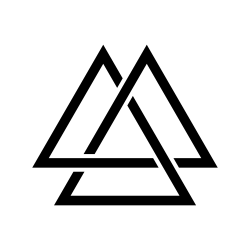
Visual Core (the baseline shape): Three interlocking, overlapping triangles forming nine vertices and nine distinct internal spaces, executed either as three distinct closed triangles (borromean topology) or a single continuous self-intersecting polygon (unicursal loop)
Exoteric Keywords (surface meaning): Norse warriors, Vikings, Odin, Valhalla, death in battle, bravery, fallen heroes, sacrifice, regional heritage, knotwork
Esoteric Keywords (occult meaning): The Nine Worlds of Yggdrasil, Odin's Seðr / Mind-Binding (Herfjöturr), Psychopomp Transit, Thread of Wyrd (Fate), Rebirth through Sacrifice, Unbinding of the Soul, The Triple Ternary ($3 \times 3 = 9$), Sacred Geometry of the Fallen
Astrological or Planetary links: Saturn (♄, Death, Fate, Limitation, Binding, Time), Mars (♂, War, Martial Valor, Blood Sacrifice), Pluto (♇, Underworld, Psychopomp Transition, Transformation), Constellation Cassiopeia / Northern Sky
Alchemical Associations: The Triple Ternary ($3 \times 3 = 9$), Fixation of the Volatile Spirit, Alchemical Binding and Unbinding (Solutio et Coagula), Prima Materia passing through Nine Stages of Purification, Caput Mortuum transmuted into Solar Valhalla
Associated Metals: Iron (Mars / Battle, Weapons, Armor), Meteorite Iron (Celestial Destiny), Silver (Lunar Psychopomp Guidance), Bronze
Traditional Colours: Obsidian Black (Death / Underworld Void), Crimson / Blood Red (Martial Sacrifice & Vital Spark), Ash Gray (Yggdrasil / Mortuary Dust), Rune-Red Ochre
Form and Origin
Natural or Material Inspiration
Inspired by natural dynamic structures that display interlocking strength and cyclic boundlessness, such as crystal lattices (specifically trigonal crystal systems), bird migration flight formations, the intricate web-spinning of spiders (Norns weaving threads of fate), and the branching root-and-limb network of trees (Yggdrasil). Materially, it mirrors three intertwined leather thongs, iron rings, or woven cords utilized in ancient sacrificial and mortuary rites to secure offerings or signify unbreakable oaths.
Geometric Philosophy
Geometrically, the valknut is a complex compound polygon built from three equilateral triangles. Because each triangle possesses 3 sides and 3 angles, the combination yields the sacred number 9—the product of the primary triad multiplied by itself ($3 \times 3 = 9$). In sacred geometry, while a single triangle represents the foundational ternary (birth, life, death), the interlocking of three triangles creates a dynamic 9-fold matrix. The shape generates nine outer vertices and nine enclosed compartments surrounding a central triangular void, symbolizing the cosmic balance between manifest reality and the unmanifest central source.
Historical Evolution of the Form
Evolved from Migration Period and Viking Age mortuary stone carvings in Scandinavia (c. 7th–10th century CE), most prominently featured on Gotland picture stones (such as the Lärbro Tängelgårda and Stora Hammars stones) and the Oseberg ship burial grave goods in Norway. In Snorri Sturluson's Prose Edda (Skáldskaparmál), the shape is linked to the legendary giant Hrungnir, whose heart was described as made of hard stone with three sharp corners (Hrungnishjarta). In modern times, the symbol was named "valknut" (derived from Old Norse valr, "slain warriors", and knut, "knot") by Scandinavian antiquarians and has become a primary emblem in Germanic Neopaganism and Heathenry.
Mythological and Cultural Context
The Origin Point
Originating in the Viking Age mortuary art of Gotland and mainland Scandinavia, where it was consistently carved alongside depictions of Odin, sacrificial altars, ravens, spears, and funerary processions. The symbol served as a sacred mark designating those warriors who died in battle (valr) and were chosen by Odin and his Valkyries to be conducted to Valhalla (Valhöll).
Cultural Migration
Synthesized through Germanic Anglo-Saxon crematory urns (such as those from Norfolk, England) and Continental Germanic relief carvings, where three-fold interlocked motifs symbolized protection over the dead. The form shares topological roots with the Celtic Triquetra and the Mediterranean Borromean Rings, migrating through medieval heraldry, woodcarving traditions in Norwegian stave churches, and modern European iconographic revivals as a symbol of ancestral remembrance and Norse spirituality.
Folklore and Ritual Use
In Viking Age ritual practice, the valknut functioned as an apotropaic mortuary talismans and a sign of consecration to Odin (Óðinn). It was marked upon burial goods, rings, and memorial stones to protect the deceased soul during its passage through the realms and to invoke Odin's power to "bind or unbind" the human mind. In Norse magic (seðr), Odin was believed to cast mental fetters (herfjöturr) upon enemies to paralyze them with fear, or unbind the minds of his favored warriors to grant them berserker fury and liberation from the fear of death.
Esoteric and Psychological Depths
Jungian Archetypes
In analytical psychology, the valknut embodies the archetype of The Hero's Sacrifice, Psychic Integration through Death, and the Ninefold Self. Carl Jung emphasized that the process of Individuation requires the symbolic "death" of the ego's limited desires so that a higher, integrated Self can be born. The three interlocked triangles represent the conscious ego, the personal unconscious, and the collective unconscious dynamically bound together, moving through trial and transformation toward psychological wholeness.
Occult and Mystical Usage
In Germanic Hermeticism, Runology, and Western ceremonial magic, the valknut represents the Nine Worlds suspended from the World Tree Yggdrasil—comprising Asgard, Vanaheim, Alfheim, Midgard, Jotunheim, Svartalfheim, Niflheim, Muspelheim, and Helheim. Practitioners utilize the valknut as a talisman for astral projection, shamanic journeying through the nine realms, and invoking the psychopomp guidance of Odin. It acts as an esoteric key for breaking psychological blockages (unbinding the mind) and consecrating sacred space for transformative work.
Dream Symbology
Dreaming of the valknut portends an impending spiritual transformation, a deep confrontation with destiny (Wyrd), or the necessary release of an outdated life phase through symbolic sacrifice. An intact, sharply defined valknut indicates spiritual protection during times of intense transition and readiness to face major challenges. A tangled or broken valknut in a dream warns of mental paralysis, fear of change, or unresolved ancestral trauma that requires inner integration.
Themes and Pairings
Core Thematic Associations
The primary themes embodied by the valknut are the knot of the slain, consecration to Odin, the Nine Worlds of Yggdrasil, psychopomp guidance, fate and Wyrd, mental binding and unbinding, sacrifice for wisdom, and the imperishable valor of the soul.
Traditional Pairings
The valknut is traditionally paired with Gungnir (Odin's Sacred Spear), Sleipnir (The Eight-Legged Horse), Huginn and Muninn (Odin's Ravens Thought and Memory), Yggdrasil (The World Ash Tree), The Triquetra, and The Horn Triskelion (Óðins horn).
Contrasting Symbols
The direct polar opposites of the valknut are the Static Unbroken Circle (representing passive, unmoving eternity without trial or sacrifice), the Soft Unstructured Line (representing chaotic dissipation without geometric discipline), and the Bind-Rune of Paralysis (representing eternal entrapment without the possibility of unbinding).
Quotations
"Hrungnir had a heart made of hard stone with three sharp corners, just like the carved symbol that has since been called Hrungnir's Heart."
Snorri Sturluson, Prose Edda (Skáldskaparmál, Ch. 17), c. 1220 CE
"The valknut stands on Gotland memorial stones at the exact point of transit between life and death... It is the graphic sign of Odin's power to bind and unbind the human mind, leading the fallen warrior from the earthly battlefield to the halls of Valhalla."
Hilda Roderick Ellis Davidson, Myths and Symbols in Pagan Europe, 1988
"Nine worlds I remember, nine roots of the tree, before the central ash sprang up from the subterranean deeps... The threefold knot marks the mystery of these realms bound together by fate."
Anonymous, Poetic Edda (Völuspá / Prophecy of the Seeress), c. 10th Century CE
Reference Library
Notable Masterworks
- Stora Hammars I Picture Stone — Viking Age Gotland Relief Carving depicting sacrificial altar, valknut, and Odin's raven (c. 8th–9th Century CE, Gotland Museum, Visby, Sweden)
- Lärbro Tängelgårda I Picture Stone — Gotland Carved Stone featuring horsemen, valknut signs, and procession of warriors (c. 8th Century CE, Historical Museum, Stockholm)
- Oseberg Ship Burial Carved Wooden Bedpost & Textile Fragments — Royal Mortuary Finds featuring valknut motifs (c. 834 CE, Viking Ship Museum, Oslo, Norway)
- Norfolk Anglo-Saxon Cremation Urns — Early Germanic Pottery stamped with triple interlocked triangle marks (c. 6th Century CE, Norwich Castle Museum, England)
Primary Texts
- Snorri Sturluson: Prose Edda (Skáldskaparmál — Description of Hrungnir's Heart and Odin's attributes)
- The Poetic Edda (Völuspá and Hávamál — Lore of the Nine Worlds, Odin's self-sacrifice, and runic binding)
- Hilda Roderick Ellis Davidson: Myths and Symbols in Pagan Europe: Early Scandinavian and Celtic Religions (Chapter on Odin, Death, and Burial Customs)