

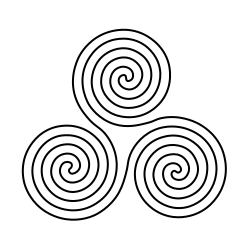
Triskelion
Symbolic Profile
Primary Name: Triskelion (Triskele)
Common Aliases: Triskele, Triquetrum, Three-Legged Whirligig, Trie Cassyn (Three Legs of Man), Trinacria (Three Capes), Triple Spiral, Triskel, Solar Whirligig, Three-Headed Swastika
Visual Core (the baseline shape): Three flexed human legs, curved branches, or stylized spirals radiating symmetrically from a single central point at 120-degree angles, creating a dynamic 360-degree rotational movement
Exoteric Keywords (surface meaning): Motion, progress, competition, three legs, running, Isle of Man, Sicily, Celtic heritage, luck, speed, cycles
Esoteric Keywords (occult meaning): Dynamic Triplicity, Perpetual Motion, Solar/Lunar Progress, Three Realms (Land, Sea, Sky), Three Solar Phases (Dawn, Midday, Sunset), The Will to Create, Cycles of Rebirth, Kinetic Equilibrium
Astrological or Planetary links: The Sun (☉, Rotational solar movement across the sky), The Moon (☽, Three lunar phases: Waxing, Full, Waning), Mercury (☿, Speed, flight, and transition), Constellation Leo / Regulus
Alchemical Associations: The Dynamic Alchemical Ternary (Sulphur, Mercury, Salt in perpetual motion), Rotatio / Circulatio, The Kinetic Aspect of Prima Materia, Transmutation of Volatiles
Associated Metals: Gold (Solar radiation and glory), Bronze (Bronze Age solar disks & shield mounts), Silver (Lunar tide currents)
Traditional Colours: Solar Gold, Crimson / Vermilion Red (Fiery momentum), Emerald Green (Celtic land vitality), Ultramarine / Ocean Blue (Marine currents & Sky)
Form and Origin
Natural or Material Inspiration
Inspired by natural dynamic phenomena that display rotational movement around a central axis, such as whirlpools, atmospheric whirlwinds, swirling water eddies, and spiral galaxy formations. Materially, it mirrors the human leg in rapid running motion (flexed at the knee and hip), the unfurling spiral fronds of ferns (koru), three coiling snakes or birds' heads joined at a central hub, and the three apparent daily moments of the sun (dawn, noon, and dusk).
Geometric Philosophy
Geometrically, the triskelion is a 3-fold rotational symmetry figure based upon three 120-degree radial vectors emanating from a central zero-dimensional point (bindu). Unlike the static, enclosed equilateral triangle, the triskelion breaks linear boundary constraints by employing curved, spiral, or hooked terminal arms. This structural curvature introduces kinetic momentum, rotational velocity, and time-evolution into the geometry. It synthesizes the sacred number 3 (the Triad of creation, preservation, and dissolution) with the perpetual motion of the circle and the wheel.
Historical Evolution of the Form
Evolved from Neolithic triple spirals carved on Megalithic monuments (such as the entrance stone at Newgrange, c. 3200 BCE) into the curvilinear metalwork of the European Bronze Age and Iron Age La Tène Celts. In classical Mediterranean antiquity, the form morphed into the three-legged trinacria on 5th-century BCE Lycian coins and 4th-century BCE Sicilian coinage under Agathocles. It continued into Insular Celtic illuminated manuscripts (Book of Durrow, Book of Kells) before being adopted in 1266 CE as the official heraldic emblem (Trie Cassyn) of the Isle of Man.
Mythological and Cultural Context
The Origin Point
Originating in Paleolithic and Megalithic sacred stone art across Atlantic Europe, most prominently in the passage tombs of Brú na Bóinne in Ireland (c. 3200 BCE). There, the triple spiral served as a sacred cosmological map tracing the sun's journey, the turning of the seasons, and the passage of the human soul through death into subterranean rebirth.
Cultural Migration
Migrated from Megalithic Western Europe into Iron Age Celtic La Tène art, where it adorned ceremonial armor, scabbards, and sacred stones (such as the Turoe Stone in Galway). Simultaneously, an independent three-legged variant (triquetrum) flourished in Asia Minor (Lycia) and Greece, appearing on the shields of Homeric heroes and coins of Pamphylia. It spread to Sicily as the symbol of Trinacria ("Three-Cornered Land") and eastwards into Buddhist and Daoist iconography as the mitsu-tomoe and the three-hares motif found in Dunhuang cave murals.
Folklore and Ritual Use
In Celtic and Greco-Roman traditions, the triskelion functioned as a potent apotropaic charm of protection, speed, and victory, blazoned upon warrior shields, helmets (such as the Agris Helmet), and neck torcs (such as the Clevedon Torc). In folk magic, its clockwise rotation (deosil) was invoked during seasonal fires and circumambulation rituals to attract solar growth, health, and prosperity, while its motto on the Isle of Man—Quocunque Jeceris Stabit ("Whithersoever you throw it, it will stand")—celebrated unshakeable stability amidst perpetual change.
Esoteric and Psychological Depths
Jungian Archetypes
In analytical psychology, the triskelion embodies the archetype of Dynamic Wholeness and Self-Actualization in Time. While the static mandala or circle depicts psychological balance in a state of rest, the triskelion represents the "Will to Create"—the psyche's active, spiraling journey of Individuation. It maps the ego's continuous movement through the three archetypal life phases (Youth/Growth, Maturity/Fulfillment, Dissolution/Rebirth) around the unshakeable axis of the Self.
Occult and Mystical Usage
In Hermetic Qabalah, Neopagan Druidry, and Western ceremonial magic, the triskelion symbolizes the threefold division of the cosmos into Sky (Celestial), Earth (Terrestrial), and Sea (Subterranean), as well as the governance of the Triple Goddess (Maiden, Mother, Crone). In alchemical operations, the triskelion acts as the graphic representation of Rotatio—the dynamic circulation and heating of the Prima Materia within the Hermetic vessel to reconcile the three alchemical principles (Sulphur, Mercury, Salt).
Dream Symbology
Dreaming of a spinning triskelion indicates rapid personal progress, incoming life momentum, and the creative breakthrough of a long-standing impasse. It signifies that three conflicting life factors are being synthesized into a unified, moving force. A clockwise triskelion in a dream heralds spiritual expansion and alignment with natural timing, whereas a counter-clockwise (widdershins) triskelion warns of regression into unconscious habits or the unravelling of past karmic ties.
Themes and Pairings
Core Thematic Associations
The primary themes embodied by the triskelion are dynamic triplicity, perpetual motion, cyclic evolution, solar/lunar progress, the three cosmic realms, swiftness, apotropaic protection, and the unceasing wheel of birth, death, and regeneration.
Traditional Pairings
The triskelion is traditionally paired with the Sun / Solar Disk (as its kinetic current), the Triple Goddess (Waxing, Full, and Waning Moon), the Swastika / Gammadion (its four-armed static counterpart), the Ouroboros (the serpent coiling around the wheel), the Spiral / Labyrinth, and the Sacred Tree of Life.
Contrasting Symbols
The direct polar opposites of the triskelion are the Static Cube / Square (representing unmoving physical density and terrestrial confinement), the Non-Dimensional Point / Unextended Dot (motionless potential without manifestation), and Broken / Irregular Lineation (representing chaotic, unintegrated entropy).
Quotations
"The triskelion, or three-armed whirligig, may refer to the sanctity of the number three and was possibly also associated with the sun... The two distinctive elements of the triskele motif are the idea of rotary movement and triplism."
Miranda J. Aldhouse-Green, Celtic Art: Symbols and Imagery, 1996
"The triskelion, a variation of these whirling symbols of the sun, is found on ancient Greek shields and Roman coins, its rays sometimes taking the form of legs, thus indicating conclusively the idea of motion, energy, victory... The triskelion proceeds apparently from the same symbolic idea of the swastika."
Thomas Wilson, The Swastika: The Earliest Known Symbol, and Its Migrations, 1896
"The triscele was used in the coinage from the time of Agathocles to symbolize the configuration of the island with three promontories... It is a figure at once so precise as the triscele or triquetra, those three legs joined together at the thigh, which radiate from a central point."
Comte Eugène Goblet d'Alviella, The Migration of Symbols, 1894
Reference Library
Notable Masterworks
- The Entrance Stone & Kerbstone 52 (Triple Spirals) — Megalithic Builders of Newgrange (c. 3200 BCE, Brú na Bóinne, County Meath, Ireland)
- The Agris Helmet (Gold-Leaf & Coral Triskelion Decor) — Celtic La Tène Masterwork (c. 350 BCE, Musée d'Angoulême, France)
- The Battersea Shield & Llyn Cerrig Bach Bronze Plaque — Insular Celtic Art featuring Bird-Headed Triskeles (c. 1st Century BCE, British Museum & Amgueddfa Cymru)
- Coins of Agathocles of Syracuse (Trinacria / Three Legs Emblem) — Classical Greek Coinage (c. 317–289 BCE, Sicily)
- Carpet Page from the Book of Durrow (Folio 3v) — Early Medieval Insular Manuscript (c. 650–700 CE, Trinity College Library, Dublin)
Primary Texts
- Comte Eugène Goblet d'Alviella: The Migration of Symbols (Chapter 1 & Chapter 2: "On the Triscele and the Gammadion")
- Miranda Aldhouse-Green: Celtic Art: Symbols and Imagery (Chapter 5: "Triplism and Multiple Images")
- Thomas Wilson: The Swastika: The Earliest Known Symbol, and Its Migrations (Section on the Triskelion and Tetraskelion, 1896)