
Crossed Keys
Symbolic Profile
Primary Name: Crossed Keys (Claves Regni / Keys of Saint Peter)
Common Aliases: Keys of Saint Peter, Claves Regni (Keys of the Kingdom), Keys of Janus, Keys of Heaven and Hell, Papal Keys, Gold and Silver Keys, Keys of Solomon, Keys of Hecate, The Binding and Loosing Keys, Dual Keys of Authority
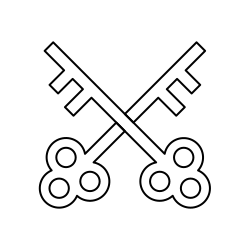
Visual Core (the baseline shape): Two skeleton or ornate keys crossed diagonally in a saltire (X-shape), traditionally one formed of gold (pointing upward/right) and one of silver (pointing upward/left), tied together at the bow by a cord or ribbon, with ward teeth turned outward and upward to form a cross
Exoteric Keywords (surface meaning): Authority, opening and closing, access, papal power, guardianship, stewardship, secrets, binding and loosing, entry, spiritual and temporal jurisdiction
Esoteric Keywords (occult meaning): Solve et Coagula (Dissolution and Coagulation), Exoteric and Esoteric Knowledge, Solar and Lunar Initiation, Janus (Ianus Patulcius / Clusivius), The Keys of the Mysteries, Passage across the Threshold, Initiation and Banishing, The Two Gates of Heaven (Janua Coeli)
Astrological or Planetary links: Janus / Saturn (♄, Gatekeeper of Time and Thresholds), The Sun (☉, Gold Key / Solar Intellect) and The Moon (☽, Silver Key / Lunar Intuition), Mercury (☿, Psychopomp and Keeper of Secrets)
Alchemical Associations: Solve et Coagula (Dissolution and Coagulation), Gold and Silver (Sol et Luna), The Key to the Closed Palace of the King (Philalethes), Unlocking the Prima Materia, Fixation of the Volatile / Volatilization of the Fixed
Associated Metals: Gold (Solar Key / Celestial Power) and Silver (Lunar Key / Terrestrial/Psychic Power), Brass, Iron (Janus/Threshold)
Traditional Colours: Gold, Silver, Papal Crimson / Red, Celestial Blue, Obsidian Black (Threshold of Secrets)
Form and Origin
Natural or Material Inspiration
Inspired by the mechanical lock and key mechanism of antiquity—crafted from bronze, iron, and precious metals—designed to secure sanctums, vaults, and city gates. Symbolically derived from the human hand holding a locking bolt, the threshold or doorway separating the profane outer world from the sacred inner sanctuary, and the diurnal rotation of the sky opening and closing the gates of day and night.
Geometric Philosophy
Combines the saltire (X-cross / St. Andrew's Cross) with dual directional loops and bit-teeth. The X-shape represents the intersection of two axes—the celestial/spiritual plane and the terrestrial/material plane—at a central axis point or pivot. The dual bows (circles) represent twin centers of awareness, while the ward teeth at the extremities represent the precise geometric alignment required to turn the tumblers of hidden law and unlock the veiled sanctuary.
Historical Evolution of the Form
Originated in ancient Roman religion with Janus (Ianus), the two-faced god of doors, gates, beginnings, and transitions, who held the key (clavium) to open (Patulcius) and shut (Clusivius) the cosmic year and the gates of heaven. In ancient Greece, keys were held by Hecate (Kleidouchos, "Key-bearer" of the Underworld and Mysteries) and Persephone. Adopted into Christianity through Gospel scripture (Matthew 16:19), where Christ gives Peter the "keys of the kingdom of heaven" (claves regni caelorum). In medieval and Renaissance heraldry, the crossed gold and silver keys became the official insignia of the Papacy and Holy See. In Western occultism, they evolved into the Clavicula Salomonis (Key of Solomon) and the dual keys of initiation in high-degree Freemasonry and Hermetic orders.
Mythological and Cultural Context
The Origin Point
Arising in ancient Mediterranean theology (c. 1000–500 BCE) with the worship of threshold deities like Janus in Rome and Hecate in Greece, where the physical key served as the ceremonial badge of the sanctuary priest or priestess (kleidouchos). The key represented sovereign access to hidden chambers, sacred mysteries, and the realms of the dead.
Cultural Migration
Migrated from classical Roman civil and religious authority into Christian theology via the Petrine ministry, where the crossed keys symbolized the dual power to "bind and loose" (ligandi et solvendi) on earth and in heaven. Spread throughout European heraldry as civic emblems for fortified gate-cities (e.g., Leiden, Bremen, Regensburg) and papal territories. In Western esoteric traditions, the symbol migrated into grimoire literature (Key of Solomon, Clavicula) and ceremonial Tarot, appearing as the crossed keys at the feet of Key V, The Hierophant (Popess / High Priest).
Folklore and Ritual Use
Used in folk magic as protective talismans hung over doorways or worn around the neck to ward off evil spirits and lock out night-demons. Applied in traditional divination practices such as "Key and Bible" divination (cleidomancy) to identify thieves or discover secrets. In papal ritual, the crossed keys are tied with crimson cords and depicted on the Sede Vacante coat of arms during the interregnum between popes, signifying the enduring spiritual stewardship of the office.
Esoteric and Psychological Depths
Jungian Archetypes
Maps directly to the archetype of the Threshold Guardian, the Shadow Gate, and the Transcendent Function. Carl Jung analyzed the key as an archetypal instrument of discovery and psychic revelation—unlocking suppressed material from the unconscious mind or granting the Ego access to the deeper wisdom of the Self. The dual crossed keys represent the balanced synthesis of conscious intellect and unconscious intuition needed to unlock psychic integration.
Occult and Mystical Usage
In Hermeticism and Qabalah, the crossed gold and silver keys represent the master keys to the Two Gates: the Solar Gate of Sun (Janua Coeli) and the Lunar Gate of Moon (Janua Inferni), corresponding to the Paths of initiation on the Tree of Life. In Tarot, the two crossed keys at the feet of the Hierophant (Key V) symbolize the exoteric (doctrine) and esoteric (gnosis) keys that unlock the mysteries of the inner temple. In alchemical philosophy, as articulated in Eirenaeus Philalethes' Introitus Apertus ad Occlusum Regis Palatium ("Open Entrance to the Closed Palace of the King"), the keys represent the specific chemical and spiritual agents required to open the sealed Hermetic vessel (Vas Hermeticum).
Dream Symbology
Symbolizes the discovery of hidden truths, new opportunities, moral authority, or the resolution of a persistent mystery. Dreaming of holding crossed keys indicates that the dreamer possesses the necessary tools or insights to solve a complex dilemma or enter a new phase of life. Dreaming of lost, broken, or rusty crossed keys signifies blocked progress, fear of the unknown, unreadiness for initiation, or a sense of excluded authority.
Themes and Pairings
Core Thematic Associations
Initiation and revelation, dual authority (spiritual and temporal), binding and loosing (Solve et Coagula), guardianship of thresholds, exoteric doctrine vs. esoteric gnosis, passage across boundaries, stewardship of secrets, and access to the divine realm.
Traditional Pairings
The Triple Tiara / Papal Crown (Sovereign Authority), The Doorway / Portal / Archway (The Threshold), The Book of Law / Scriptures (Written Gnosis), The Sentinel / Gatekeeper (Janus, Peter, Hecate), and The Golden Cord / Ribbon.
Contrasting Symbols
The Padlock / Sealed Vault (Inaccessible mystery, hidden state), The Shattered Gate / Forced Entry (Violence, desecration, lack of initiation), and The Blind Wall (Impassable barrier without a keyway).
Quotations
"I will give you the keys of the kingdom of heaven; whatever you bind on earth will be bound in heaven, and whatever you loose on earth will be loosed in heaven."
Gospel of Matthew (Matthew 16:19, New Vulgate / Latin Claves Regni)
"The two keys at the feet of the Hierophant are the keys of the Sanctuary, the keys of binding and loosing, of exoteric doctrine and esoteric wisdom... One is of gold, representing the solar spirit; the other is of silver, representing the lunar soul."
Arthur Edward Waite, The Pictorial Key to the Tarot (1910, Part II, Key V)
"The keys of Janus open the two cosmic doors: the gate of the winter solstice, which leads to the ascent of the gods, and the gate of the summer solstice, which leads to the descent of souls. He who holds the dual keys holds the power over time and eternity."
René Guénon, Fundamental Symbols: The Universal Language of Sacred Science (1962, Ch. 37, 'The Two Solstitial Gates')
Reference Library
Notable Masterworks
- Christ Handing the Keys to Saint Peter — Pietro Perugino (c. 1481–1482, Sistine Chapel, Vatican Palace, Rome)
- The Coat of Arms of the Holy See and Vatican City State — Papal Heraldry (Featuring the crossed Gold and Silver Keys bound by a Gules Cord under the Tiara)
- The Hierophant (Key V, Rider-Waite-Smith Tarot Deck) — Pamela Colman Smith & Arthur Edward Waite (1909)
- Janus holding the Key and Scepter — Classical Roman Coinage & Engravings (Cabinet des Médailles, Paris)
Primary Texts
- The Gospel According to Saint Matthew (Chapter 16: The Petrine Promise and the Keys of Heaven)
- Eirenaeus Philalethes: Introitus Apertus ad Occlusum Regis Palatium (Open Entrance to the Closed Palace of the King, 1667)
- René Guénon: Fundamental Symbols (Chapter 37: 'The Two Gates of the Year' and the Symbolism of Janus)