Cross of Lorraine
Symbolic Profile
Primary Name: Cross of Lorraine
Common Aliases: Cross of Anjou, Patriarchal Cross, Double Cross, Crux Patriarchalis, Cross of Free France, Two-Barred Cross, Cross of Brabant
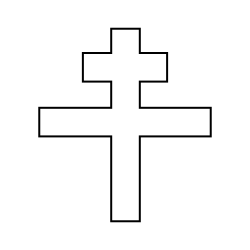
Visual Core (the baseline shape): A vertical staff intersected by two horizontal crossbars, with the upper bar traditionally shorter than the lower bar
Exoteric Keywords (surface meaning): Resistance, liberation, Lorraine, France, Joan of Arc, heraldry, double cross, patriarchy, sovereignty, duty
Esoteric Keywords (occult meaning): Dual Spheres of Manifestation, Upper and Lower Heavens, Hermetic Axiom ("As Above, So Below"), Dual Salvation, Regal and Priestly Authority, Alchemical Scale (Scale Philosophorum), Hermetic Axis of Equilibrium
Astrological or Planetary links: Sun (Sol / Regal Sovereignty), Jupiter (Patriarchal/Episcopal Authority), Mercury (Hermetic Axis of Dual Transmutation)
Alchemical Associations: Fixation of Volatiles, Alchemical Quicksilver / Mercury, Dual Distillation, The Double Seal, Sulfur and Salt Equilibrium, Alchemical Vitriol
Associated Metals: Gold (Solar Sovereignty), Iron (Martial Resistance), Bronze (Episcopal Endurance)
Traditional Colours: Royal Blue, Crimson / Gules Red, Gold, Pure White
Form and Origin
Natural or Material Inspiration
The Cross of Lorraine derives its physical structure from ancient timber scaffolding, double-bracketed architectural supports, and the ceremonial processional staves carried by Byzantine and Western Christian patriarchs. Its dual horizontal bars mirror the titulus (the sign attached above the cross bearing the INRI inscription) combined with the primary transom of crucifixion, as well as two-tiered scales or balance beams used in ancient commerce and sacred weight-measuring rites.
Geometric Philosophy
Geometrically, the symbol consists of a central vertical staff intersected by two transverse horizontal line segments, creating a six-pointed or eight-pointed directional grid. The upper, shorter crossbar represents the upper celestial sphere (the spiritual realm or divine titulus), while the lower, longer crossbar represents the terrestrial/material plane. In sacred geometry, this structure embodies the Hermetic axiom "As Above, So Below," representing the double reflection of divine law into physical manifestation through a central vertical axis of mediation.
Historical Evolution of the Form
The form originated in Byzantium as the Patriarchal Cross, used by archbishops and patriarchs of the Eastern Orthodox Church as a symbol of clerical hierarchy. In the 14th century, René of Anjou adopted it after inheriting the Duchy of Lorraine, transforming the Patriarchal Cross into the heraldic emblem of the House of Anjou-Lorraine. The symbol achieved global political renown in the 20th century when General Charles de Gaulle and Admiral Émile Muselier adopted the Cross of Lorraine as the official emblem of Free France (France Libre) and the French Resistance against Nazi occupation, consciously contrasting its balanced two-barred geometry against the crooked swastika.
Mythological and Cultural Context
The Origin Point
The earliest archaeological and iconographic appearances of the two-barred cross trace back to 9th-century Byzantine coinage, reliquaries of the True Cross (such as the Reliquary of True Cross of St. Trophime in Arles and the Staurotheke of Limburg), and imperial seals. In early Christian Levant and Byzantium, the upper bar held the inscription of Pontius Pilate (Jesus of Nazareth, King of the Jews), serving as a talismanic sign of imperial protection and divine victory (Nika).
Cultural Migration
As the symbol migrated westward during the Crusades through royal dynastic alliances and chivalric orders, it was adopted by the Kings of Hungary (appearing on the Hungarian coat of arms under King Béla III in the 12th century). The symbol traveled to France via Louis I, Duke of Anjou, who enshrined it in the famous Apocalypse Tapestry of Angers. It subsequently became the official heraldic charge of the Dukes of Lorraine. In Esoteric and Rosicrucian circles, the double cross spread throughout Western Europe as an alchemical symbol for vitriol, spirit-matter transmutation, and high-degree Freemasonry.
Folklore and Ritual Use
In European folk traditions and religious devotions, the Cross of Lorraine was revered as a powerful apotropaic charm against pestilence, fever, and demonic possession—famously known in regional lore as the "Cross of Cholera" or "Cross of Caravaca" (a variant two-barred cross). In heraldic and military ceremonies, it was embroidered onto battle standards, military medals (the Ordre de la Libération), and resistance monuments across France. In Catholic liturgy, double-barred processional crosses are carried exclusively before archbishops, cardinals, and patriarchs during solemn ecclesiastical processions.
Esoteric and Psychological Depths
Jungian Archetypes
In analytical psychology, the Cross of Lorraine represents the archetype of Dual Integration and the Axis of Equilibrium. Beyond the single crossbar of simple binary tension, the double crossbar maps a two-tiered psychological structure: the upper bar represents the integration of higher conscious ideals and spiritual aspirations, while the lower bar represents the harmonization of instinctual shadow drives on the earthly plane. Together along the central vertical staff, they symbolize the ego's capacity to mediate between superconscious wisdom and unconscious instinct.
Occult and Mystical Usage
In Hermeticism, Alchemy, and Rosicrucian tradition, the Cross of Lorraine is an operational glyph for dual distillation and the secret Scale Philosophorum (Philosopher's Ladder). It signifies the double fixation of volatile mercury and the harmonization of the macrocosmic and microcosmic realms. In Hermetic Qabalah and esoteric Masonry (such as the Grand Orient and Scottish Rite 33rd Degree), the two bars represent the two primary pillars or thresholds of initiation (Jachin and Boaz) synthesized upon the central pillar of mildness (Sushumna / Middle Pillar).
Dream Symbology
Dreaming of a Cross of Lorraine portends a period of profound spiritual fortitude, righteous resistance against oppression, and the need to establish balance across two distinct areas of life. A shining or golden double cross signifies divine authorization, moral victory, and the resolution of double conflicts. A heavy or wooden double cross indicates that the dreamer is carrying a double burden or responsibility, but possesses the spiritual resilience required to achieve ultimate liberation.
Themes and Pairings
Core Thematic Associations
The primary themes embodied by the Cross of Lorraine are noble resistance, dual salvation, liberation from tyranny, Hermetic equilibrium ("As Above, So Below"), double authority (temporal and spiritual), heraldic sovereignty, and the sacred hierarchy of manifestation.
Traditional Pairings
The Cross of Lorraine is traditionally paired with the Fleur-de-lis (French royal heraldry), the V for Victory / Free France Flag, Joan of Arc's Banner, the Crown of Thorns, the Alchemical Crucible / Furnace, the Thistle of Lorraine, and the Phoenix.
Contrasting Symbols
The direct polar opposites of the Cross of Lorraine are the Swastika / Hakenkreuz (representing tyrannical oppression and crooked motion vs. noble resistance and geometric balance), the Broken / Single Cross (representing incomplete or asymmetrical manifestation), and Chaos / Entropic Dispersion.
Quotations
"Under the sign of the Cross of Lorraine, the Free French forces fought for the liberation of their homeland, turning an ancient symbol of patriarchal faith into the eternal banner of national resistance and freedom."
Adele Nozedar, The Element Encyclopedia of Secret Signs and Symbols, 2008
"The doubled cross is expressive of parallel forces... marrying the horizontal plane of terrestrial existence at two distinct levels with the single vertical axis of divine spirit."
J. E. Cirlot, A Dictionary of Symbols, 1962
"In the heraldic science of the Hermetic tradition, the two-barred cross of Lorraine and Anjou stands as the alchemical scale—the dual seal of spirit and matter reflecting the eternal truth of 'As Above, So Below.'"
Julius Evola, The Hermetic Tradition: Symbols and Teachings of the Royal Art, 1931
Reference Library
Notable Masterworks
- The Apocalypse Tapestry of Angers — Nicolas Bataille & Jean de Bondol (c. 1373–1382, Château d'Angers, France)
- Mémorial Charles de Gaulle (Monumental Cross of Lorraine) — Marc Leboucher & Jean Roubert (1972, Colombey-les-Deux-Églises, France)
- Reliquary of the True Cross of Lorraine (Staurotheke) — Byzantine / Medieval Metalsmithing (c. 11th–12th Century, Cathedral of St. Gatien, Tours)
- Coat of Arms of the Kingdom of Hungary & Duchy of Lorraine — Medieval Royal Heraldic Regalia (c. 12th–15th Century)
Primary Texts
- Adele Nozedar: The Element Encyclopedia of Secret Signs and Symbols (Section on Heraldic and Resistance Crosses)
- J. E. Cirlot: A Dictionary of Symbols (Entry on "Cross" and "Doubled Cross")
- Julius Evola: The Hermetic Tradition (Treatise on Hermetic Heraldry and Alchemical Sigils)