

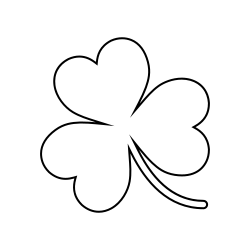
Shamrock
Symbolic Profile
Primary Name: Three Leaf Clover (Shamrock)
Common Aliases: Shamrock, Trefoil, Trifolium, Seamróg, Shamrakh, Plant of the Trinity, Triple Goddess Leaf, Emerald Triad
Visual Core (the baseline shape): Three heart-shaped (cordate) leaflets radiating symmetrically from a single central stalk, forming an organic trefoil or triquetra configuration
Exoteric Keywords (surface meaning): Ireland, good fortune, spring, nature, growth, triplicity, health, blessing, regional identity, luck
Esoteric Keywords (occult meaning): The Triad / Triplicity, The Triple Goddess (Virgin, Mother, Crone), The Holy Trinity, Reconciliation of Opposites, Three Realms (Land, Sea, Sky), Protection against Malefic Forces, The Trefoil Key
Astrological or Planetary links: Mercury (Ruler of triplicity, intellect, and communication), Moon (Lunar phases of the Triple Goddess), Sun (Beltane spring awakening and solar warmth)
Alchemical Associations: The Alchemical Ternary (Sulphur, Mercury, Salt), Solution of Duality through a Reconciling Third Principle, Prima Materia in threefold vegetative growth, Green Dragon / Vitriol
Associated Metals: Copper (Venus / Vegetative Life), Quicksilver / Mercury (Fluid Ternary), Bronze
Traditional Colours: Emerald Green, Forest Green, White (Purity / Trinity Light), Gold (Solar Illumination)
Form and Origin
Natural or Material Inspiration
The symbol of the three-leaf clover derives directly from Trifolium repens (white clover) and related trifoliate flora native to temperate pastures across Europe, Asia, and North Africa. Characterized by three heart-shaped leaflets originating from a single central stem, clover is celebrated for its rapid spring emergence, creeping growth habit, and remarkable soil-enriching nitrogen fixation. To ancient agricultural societies, the plant served as a ubiquitous, living testament to the generative vitality of the earth, environmental resilience, and the innate tendency of nature to express structural wholeness in groupings of three.
Geometric Philosophy
Geometrically, the three-leaf clover is the botanical realization of the Triad and the triquetra. Built upon three overlapping circles or vesicas radiating at 120-degree angles from a shared center, the trefoil geometry embodies the resolution of binary conflict (1 + 2 = 3). The cordate (heart) shape of each individual leaflet unites the emotional and vital center with the structural logic of sacred geometry. In the language of form, while two opposing forces create static tension, the addition of the third leaflet acts as the dynamic, mediating vector that transforms flat polarity into a self-sustaining, organic whole.
Historical Evolution of the Form
The visual history of the trefoil spans millennia, originating in the Indus Valley civilization (c. 2500 BCE) and the ancient Near East, where trefoil motifs (shamrakh) adorned sacred garments, royal robes, and depictions of the Mother Goddess. In Atlantic Europe and the British Isles, Celtic Druids held three-leaved plants in high reverence as sacred symbols of the threefold division of the cosmos and the land-goddesses. During the early medieval Christianization of Ireland (traditionally attributed to St. Patrick in the 5th century CE), the native clover leaf was adopted as a pedagogical emblem to explain the mystery of the Holy Trinity. In Gothic architecture, this form evolved into the three-lobed trefoil arch, while in heraldry and card iconography it became the suit of Clubs (Trèfle).
Mythological and Cultural Context
The Origin Point
The three-leaf clover emerged as a sacred emblem in European and Near Eastern prehistory, intimately tied to the worship of earth and sky deities. In early Irish and Celtic traditions, the plant was consecrated to the tutelary triple goddesses of sovereignty—Ériu, Banba, and Fódla—as well as the triple manifestation of Brigit (goddess of poetry, healing, and smithcraft). The natural triplicity of the leaf made it an ideal sacred plant (biomurcha) used by Druidic priests to mark seasonal cycles and communicate with the spirits of the land.
Cultural Migration
As Christian monasticism expanded throughout Ireland and Western Europe, indigenous triadic symbols were integrated into Christian lore rather than eradicated. The legend of St. Patrick plucking a shamrock from the soil at the Rock of Cashel to illustrate "three Persons in one God" successfully translated Druidic veneration of the number three into orthodox trinitarian theology. The symbol subsequently migrated into Western heraldry as the cross trefflée (a cross whose arms end in clover leaves) and into French royal design as the stylized fleur-de-lis, retaining its association with divine favor, royal sovereignty, and spiritual protection.
Folklore and Ritual Use
In traditional folk magic, the three-leaf clover served as a powerful apotropaic charm against malevolent spirits, witches' hexes, and the evil eye. Bringing clover into the home or wearing it tucked into a hatband was believed to safeguard the bearer and ensure domestic prosperity. On St. Patrick's Day (March 17), the customary ritual of "drowning the shamrock"—placing the leaf into the final cup of whiskey before drinking a toast—celebrated community solidarity and the return of spring. Farmers also gathered clover on Beltane (May 1) and Midsummer Eve to feed to livestock as a fertility rite and protection against disease.
Esoteric and Psychological Depths
Jungian Archetypes
In analytical psychology, the three-leaf clover embodies the archetype of Synthesis and the Transcendent Function. Carl Jung noted that while two represents dualistic opposition (ego vs. shadow, light vs. dark), three represents the creative emergence of a third element that reconciles the conflict and elevates the psyche to a higher state of integration. The three leaflets radiating from a single stem reflect the mind's subconscious drive toward wholeness, mapping the harmonious union of the conscious ego, the personal unconscious, and the collective archetypal realm.
Occult and Mystical Usage
In Hermeticism, Qabalah, and Western ceremonial magic, the trefoil corresponds to the Supernal Triad atop the Tree of Life—comprising Kether (The Crown), Chokmah (Wisdom), and Binah (Understanding)—as well as the alchemical triad of Sulphur, Mercury, and Salt. In Druidic revivalism and Wiccan practice, the shamrock is utilized as a sacred tool to open the mind to the three realms of existence: Sky (Celestial/Spirit), Earth (Terrestrial/Body), and Sea (Subterranean/Soul). It functions as a meditative mandala for balancing past, present, and future within the eternal present moment.
Dream Symbology
Dreaming of a vibrant, green three-leaf clover portends spiritual alignment, emotional healing, and incoming good fortune. It indicates that a period of inner conflict or indecision is reaching a harmonious resolution through a balanced, creative breakthrough. Holding or gathering three-leaf clovers in a dream signifies that the dreamer is surrounded by protective energies, encouraging them to move forward with confidence in new personal, creative, or spiritual endeavors.
Themes and Pairings
Core Thematic Associations
The primary themes associated with the three-leaf clover are organic triplicity, divine protection, environmental synthesis, fertile renewal, the reconciliation of opposites, spiritual grace, the balance of nature's three realms, and the sacredness of the number three.
Traditional Pairings
The three-leaf clover is traditionally paired with the Triquetra (its geometric counterpart), the Triple Moon / Triple Goddess symbol, St. Patrick's Staff or Crozier, the Holy Chalice / Cauldron of Regeneration, the Four-Leaf Clover (its rare fourfold mutant counterpart signifying fortunate anomaly), the Cross Trefflée, and the Ogham Tree Alphabet.
Contrasting Symbols
The direct polar opposites of the three-leaf clover are the Unresolved Dyad (representing binary conflict and division), the Static Cube / Square (representing rigid material containment without organic fluidity), and the Reaping Scythe or Sickle (representing severing and mortality vs. flourishing vegetation).
Quotations
"On St. Patrick’s Day everyone is decorated with a shamrock, for it was with this plant that our patron saint taught the pagan Irish the mystery of the Blessed Trinity."
John Creedon, An Irish Folklore Treasury, 2022
"One of the earliest emblems of trinitarian divinity, known as far back as the Indus Valley civilization... the trefoil was sacred in the eyes of many Indo-European peoples. Irish Celts even had a god of the trefoil... His emblem was eventually assimilated to the legend of Saint Patrick."
Barbara G. Walker, The Woman's Dictionary of Symbols and Sacred Objects, 1988
"Clover (or Trefoil). An emblem of the Trinity. When it is located upon a mountain it comes to signify knowledge of the divine essence gained by hard endeavour, through sacrifice or study... Trifoliate forms, such as the Gothic three-lobed arch, bear the same significance; and, broadly speaking, so do all tripartite forms."
J. E. Cirlot, A Dictionary of Symbols, 1962
Reference Library
Notable Masterworks
- St. Patrick Preaching at Tara with the Shamrock — Insular Stained Glass & Manuscript Traditions (e.g., St. Patrick's Cathedral, Dublin)
- The Book of Kells (Folio 33r / Trefoil and Spiral Illuminations) — Insular Gospel Masterwork (c. 800 CE, Trinity College Library, Dublin)
- Gothic Trefoil Tracery Windows — High Medieval Cathedral Architecture (c. 12th–14th Century, e.g., Notre-Dame de Paris & Chartres Cathedral)
- Collar of the Most Illustrious Order of Saint Patrick — British & Irish Chivalric Regalia featuring Enamelled Trefoils (1783)
Primary Texts
- An Irish Folklore Treasury (John Creedon & Irish Folklore Commission Archives)
- Cormac's Glossary (Sanas Cormaic, 9th Century Irish Text detailing the Triple Goddess Brigit and sacred lore)
- The Woman's Dictionary of Symbols and Sacred Objects (Barbara G. Walker, 1988)